
Most developers who answered Stack Overflow's 2026 survey now use AI every day. Yet only 20% use it to deploy, operate or troubleshoot production systems. That gap tells you more about how teams really work with AI than most of the headlines built on the survey.
The survey everyone is quoting, and why the source matters
The 2026 Developer Survey is the 16th edition. Over seven weeks, more than 30,000 people from 169 countries took it, and the results came out on 6 October 2026.
But "30,000" is the size of the whole survey, not of every answer. The survey asks 103 questions across 5 categories, and each AI question shows its own count. The trust question was answered by 14,304 people. The source attribution question by 13,945. So when a headline says "developers think X", it really describes the people who answered that one question.
Second-hand coverage also reframes the numbers. IT Brief reports that 78.7% say source attribution matters. Stack Overflow's own blog says 93%. Both are right. They count different answers to the same question, and we unpack that below.
Here's what you get: the real figures, what each one counts, a second opinion from Sonar's State of Code survey, and what we would do on a small team.
Daily use is real: 73% daily, and a third of daily users put in 4+ hours
73% of respondents who use AI coding assistants or agents use them daily. Among daily AI users, 80.7% spend at least an hour a day with AI and 31.1% spend four hours or more, according to IT Brief's breakdown. The Stack Overflow blog rounds that to "a third".
Sentiment rose along with use. 62% of all respondents view AI at least somewhat positively, and that jumps to 71% among daily users.
The longer trend, from Stack Overflow's survey retrospective: AI tool use was 44% in 2023, 62% in 2024 and 79% in 2025.
"66% use agents" is not quite what the survey says
The 66% figure that travels around is the share using "coding assistants or agents" (65.9%). Autocomplete-style assistants and agents sit in one bucket. Here's the full picture:
- Coding assistants or agents: 65.9%
- General-purpose chat tools: 62.5%
- Automated agent workflows: 26.2%
- No AI tools at all: 17.2%
Automated agent workflows are the closest thing to agents working on their own. About a quarter of respondents use them.
The other famous figure, "Claude Code used by 66%", needs the same care. On the survey's AI page, Claude Code (66%) and GitHub Copilot (59%) lead among coding agents. The page doesn't say how many people this figure is based on, so it likely reflects the people who answered the coding-agent question rather than all 30,000 respondents, but don't read it as two-thirds of the whole survey. For orchestration, respondents use LangChain (30%) and OpenAI Agents SDK (24%). For automation, Make (39%) and n8n (33%).
Stack Overflow's April 2026 pulse survey of 1,100 people adds context. Agent use at work rose from 31% in the 2025 survey to 59%. Yet agents stay on a leash:
- 63% rarely or never let agents run fully on autopilot
- 60% block agents from making unapproved system changes
- 68% prefer predictable single-agent setups over multi-agent ones
The leader flips there, too. In the pulse survey GitHub Copilot (61%) is ahead of Claude Code (51%) among code assistants, with OpenAI Codex and Cursor at 20% each. Different samples, different months, so don't treat either ranking as final.
Where AI works and where it is kept out: 67% familiar code, 20% production
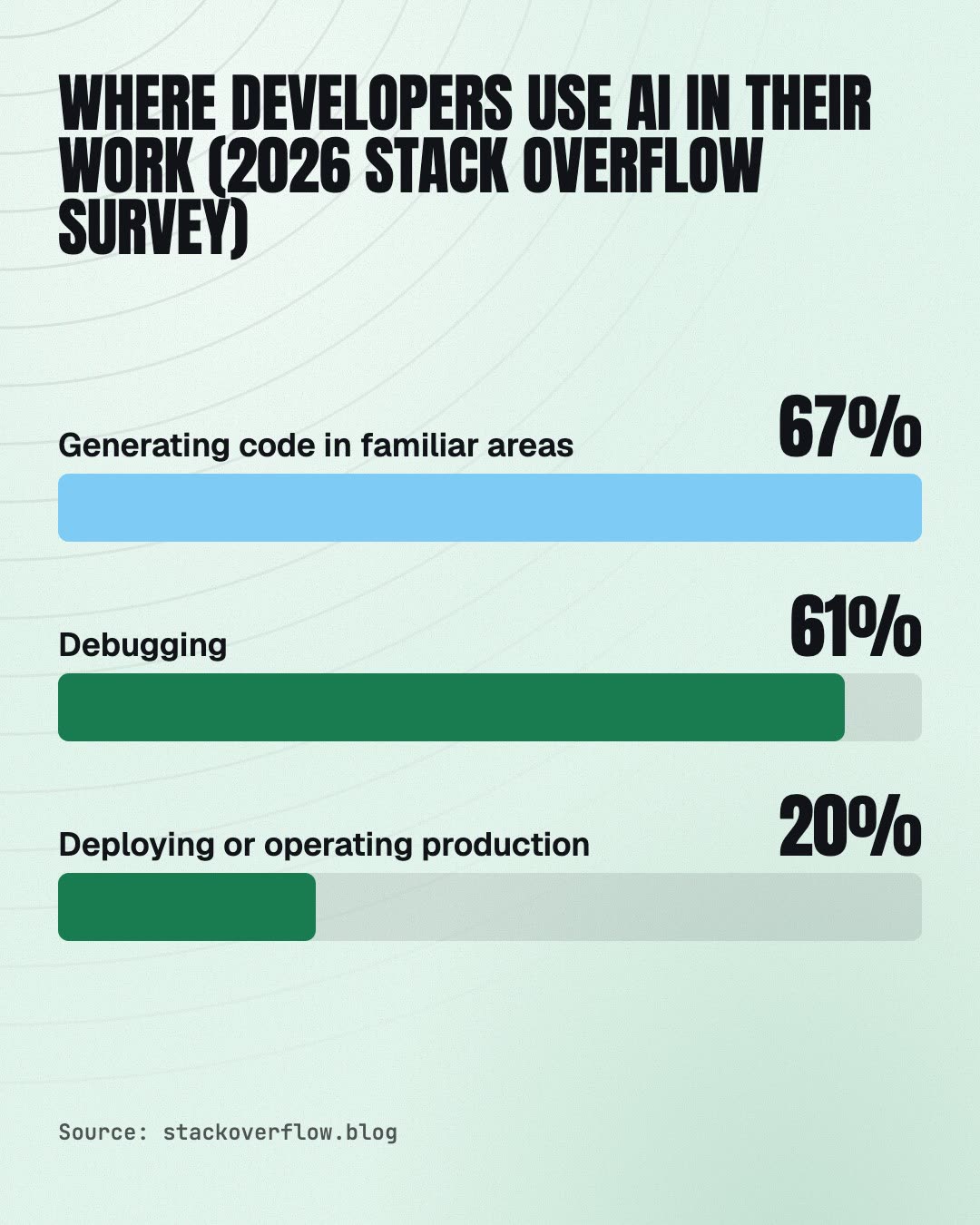
When developers build with AI, it's mainly to generate code in familiar areas (67%) and to debug (61%). Only 20% use it to deploy, operate or troubleshoot production systems. Stack Overflow's own summary is short:
Basically, developers trust AI with machines but not with people.
Stack Overflow Developer Survey 2026
Our reading: the line most teams draw isn't "AI or no AI". It's "AI where a human can quickly check the result". Production is where mistakes cost the most and are hardest to undo.
The same pattern shows in how people look for answers. 83% still ask a search engine and 70% ask AI. 64% visit Stack Overflow less for simple questions, while 16% visit more just to check the source behind an AI answer.
Trust: 48% trust AI only when they can verify it
Here's how the 14,304 people who answered the trust question split:
- 48% trust it when they can verify the output
- 16% trust it for many tasks, but not important decisions
- 16% trust it for low-risk tasks only
- 12% don't trust it for most work
- 7% trust it for many tasks and decisions (IT Brief gives 6.6%)
Stack Overflow's headline says more than 87% have "some level of trust" in AI output, up from 31% last year. That number adds every conditional answer together, and more than half of it is "only when I can verify".
What "93% want attribution" really counts
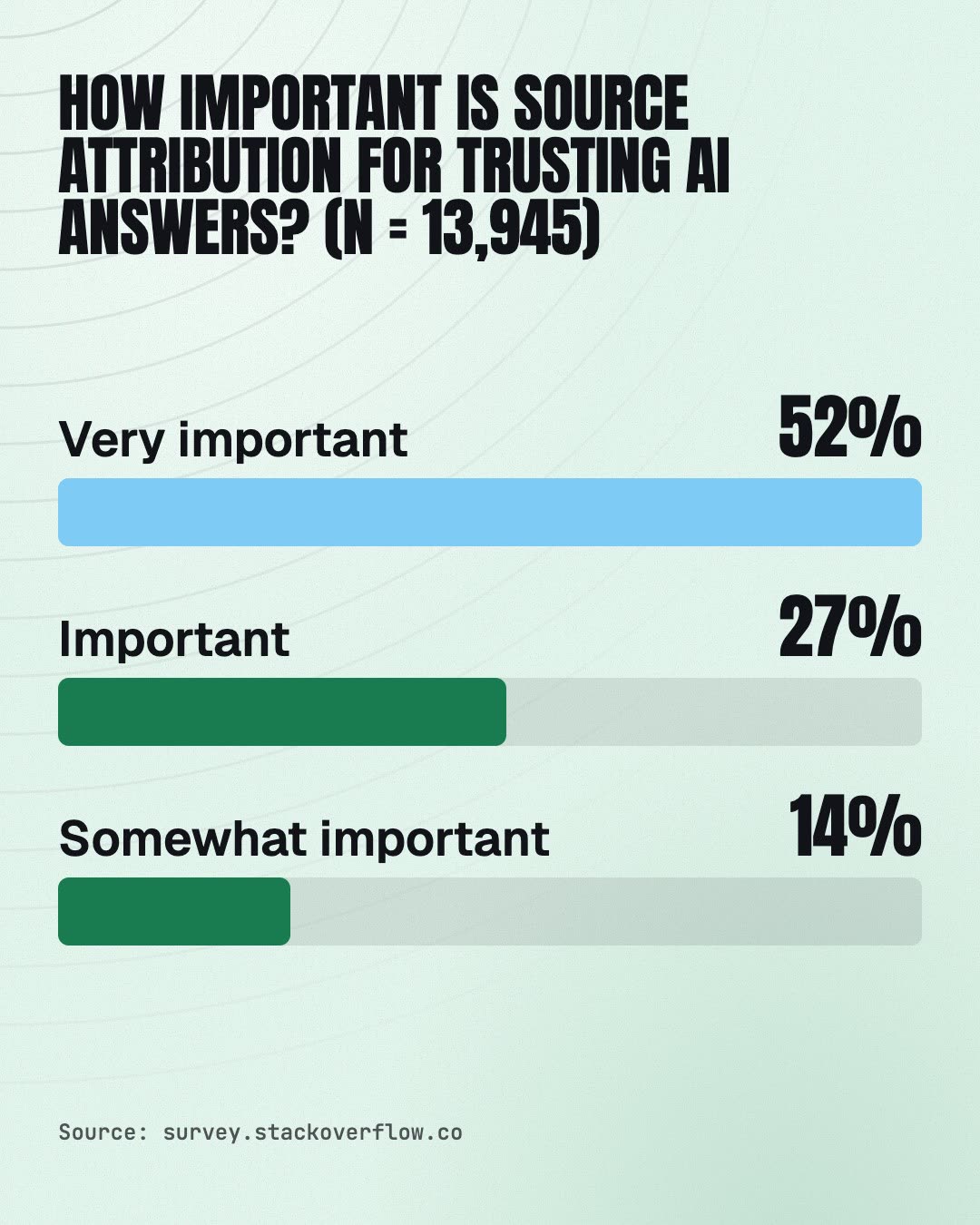
On source attribution (n = 13,945), 52% said very important, 27% important and 14% somewhat important. The blog's 93% adds all three. IT Brief's 78.7% counts only the first two. Same question, different cut.
The blog also names the best sources of trusted context: project goals and requirements (85%) and code and docs (73%). In practice, an agent without your requirements and your repo is working blind.
Cost is now a line item: 38% of organisations cap AI usage
Developers put quality ahead of cost when shaping prompts and picking models (75% vs 38%). Their organisations are adding controls anyway:
- 38% set limits on usage
- 28% reviewed spending data
- 27% use different models for different work
- 25% limit who gets to use AI
On the other side, 21% say their organisation is spending more. And in the pulse survey, the share who see cost as a barrier to agents fell from 53% to 38%. Budgets are being managed rather than used as a reason not to adopt.
For a small team, an uncapped token bill becomes a real risk once several people run agents for hours a day (remember the 31.1% at four hours or more). Routing different models to different work is a simple control that more than a quarter of organisations already use.
A second opinion from Sonar, and the limits of both surveys
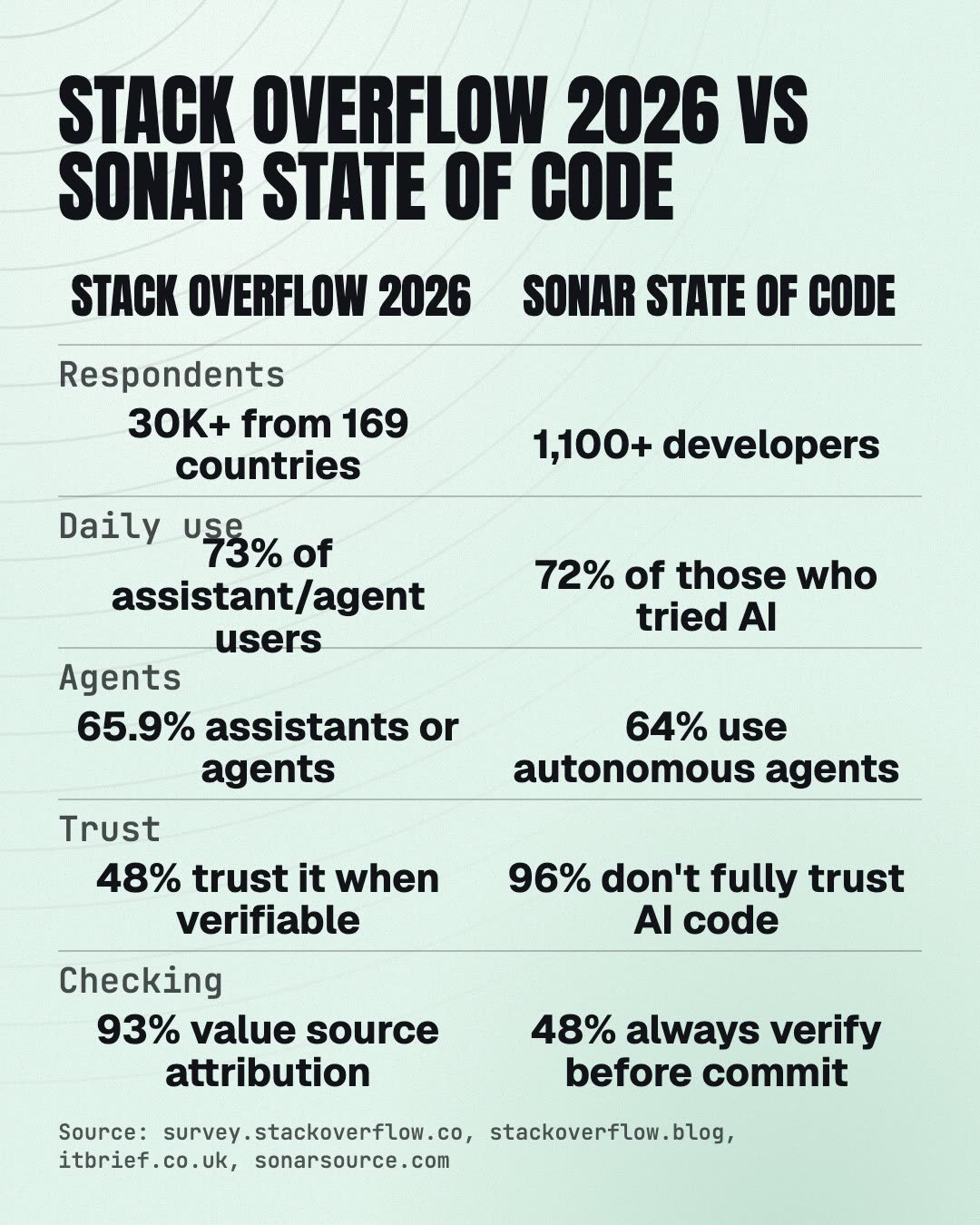
Sonar's State of Code survey (1,100+ developers, released 8 January 2026) agrees on adoption. 72% of developers who have tried AI use it every day. AI accounts for 42% of committed code, which they expect to reach 65% by 2027. 64% have started using autonomous agents.
It also shows the review side. 96% don't fully trust that AI-generated code is functionally correct, yet only 48% always check it before committing. 38% say reviewing AI code takes more effort than reviewing a colleague's. And 35% use AI coding tools through personal accounts rather than work-sanctioned ones.
Effectiveness is uneven too. According to Sonar's report, 90% use AI for new code, but only 55% of them rate it extremely or very effective there. Writing documentation scored highest, at 74%.
What neither survey can tell you
- Both samples are self-selected. Stack Overflow recruits mainly through its own channels, so highly engaged users are more likely to answer, as its 2025 methodology says.
- Sonar sells code verification, so the verification gap is its core topic.
- The sample shrank. 30,000+ in 2026 vs 49,009 responses in 2025, so treat year-over-year swings with care.
- The AI questions are smaller still, around 14,000 answers for trust and attribution.
- No cross-tabs yet. The full dataset comes out in the coming weeks, so splits such as company size aren't available.
What we would do on a small team this quarter
- Keep AI on familiar code first. Generation, debugging, tests and docs, where you can check the result quickly. Keep production operations human-led with AI assisting: only 20% of respondents use AI to deploy, operate or troubleshoot production systems.
- Verify by default. Ask that AI output carries its source (a file, a doc, a link) and run automated checks before merging. Sonar's gap, 96% distrust vs 48% always checking, is what you get when checking is left to good intentions.
- Give agents real context. Put requirements and the relevant code and docs where the agent can read them. Those are the two contexts developers trust most (85% and 73%).
- Set a budget before you need one. A monthly cap per person or project, a look at spend data every month, and a cheaper model for simple tasks. Use work accounts so the spend and the data stay visible.
The short version
Developers use AI every day, keep it on code they can check and are starting to put budgets on it. The headline numbers are mostly accurate but count more than they seem to. Surveys show the direction. Your team's own measurements tell you what to do. For practical AI workflow guides, head to Learn.