
If you run Gemini 4 Argon in production, your December bill is already set: every rate doubles on December 1. You have until November 30 to measure your usage, change what you can, and write a budget that matches the new prices.
Argon became generally available on October 13, 2026 at an introductory $2 per 1M input tokens and $10 per 1M output tokens (AIHubMix). That intro rate was never meant to last. Here's what changes, what it means per task, and the four moves we'd test this month.
Every Argon rate doubles on December 1
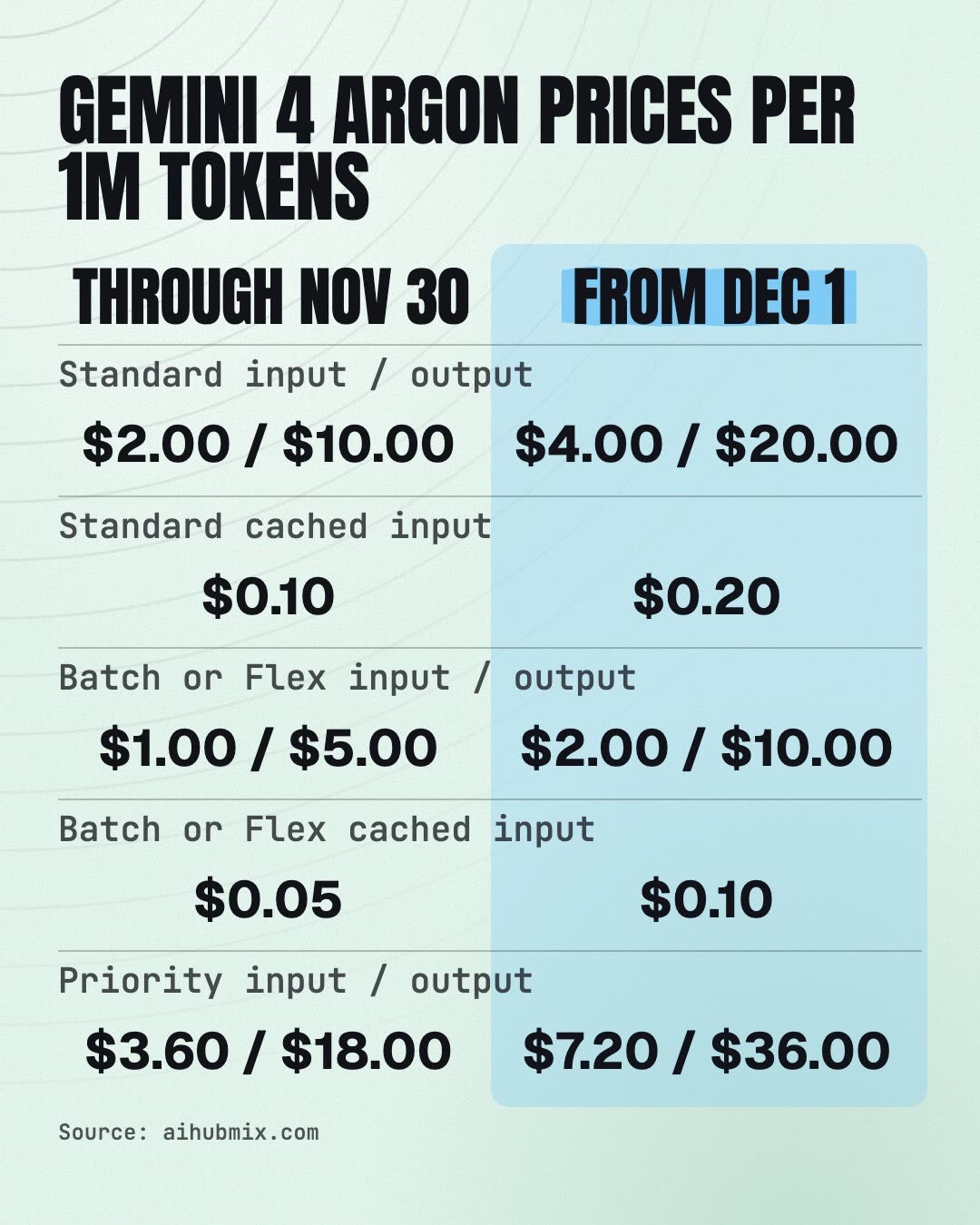
Google's Gemini API pricing page lists the current rates "through November 30, 2026" and the new ones "from Dec 1, 2026". Every line doubles:
- Standard: $2 / $10 per 1M input / output tokens → $4 / $20
- Batch and Flex: $1 / $5 → $2 / $10
- Priority: $3.60 / $18 → $7.20 / $36
- Cached input (standard): $0.10 → $0.20 per 1M tokens
AIHubMix and ActuIA quote the same rates on every tier, and we checked the table below against Google's page. Batch and Flex are still half of standard after December 1. That's the same price as today's standard rate.
A few lines on the pricing page are easy to miss:
- The output price includes thinking tokens. Google says every token the model processes is billed, thinking included.
- Argon is not on the free tier.
- Caching is implicit only. Explicit caching isn't supported.
- Search grounding: 5,000 free requests a month, shared across all Gemini 3 and newer models, then $14 per 1,000 requests, with a cap of 1,500 requests a day.
On Google Cloud, the EU endpoint adds 10%: $4.40 / $22 from December 1 (ActuIA). If you're on Vertex, check the price for your region.
Why cost per task matters more than cost per token
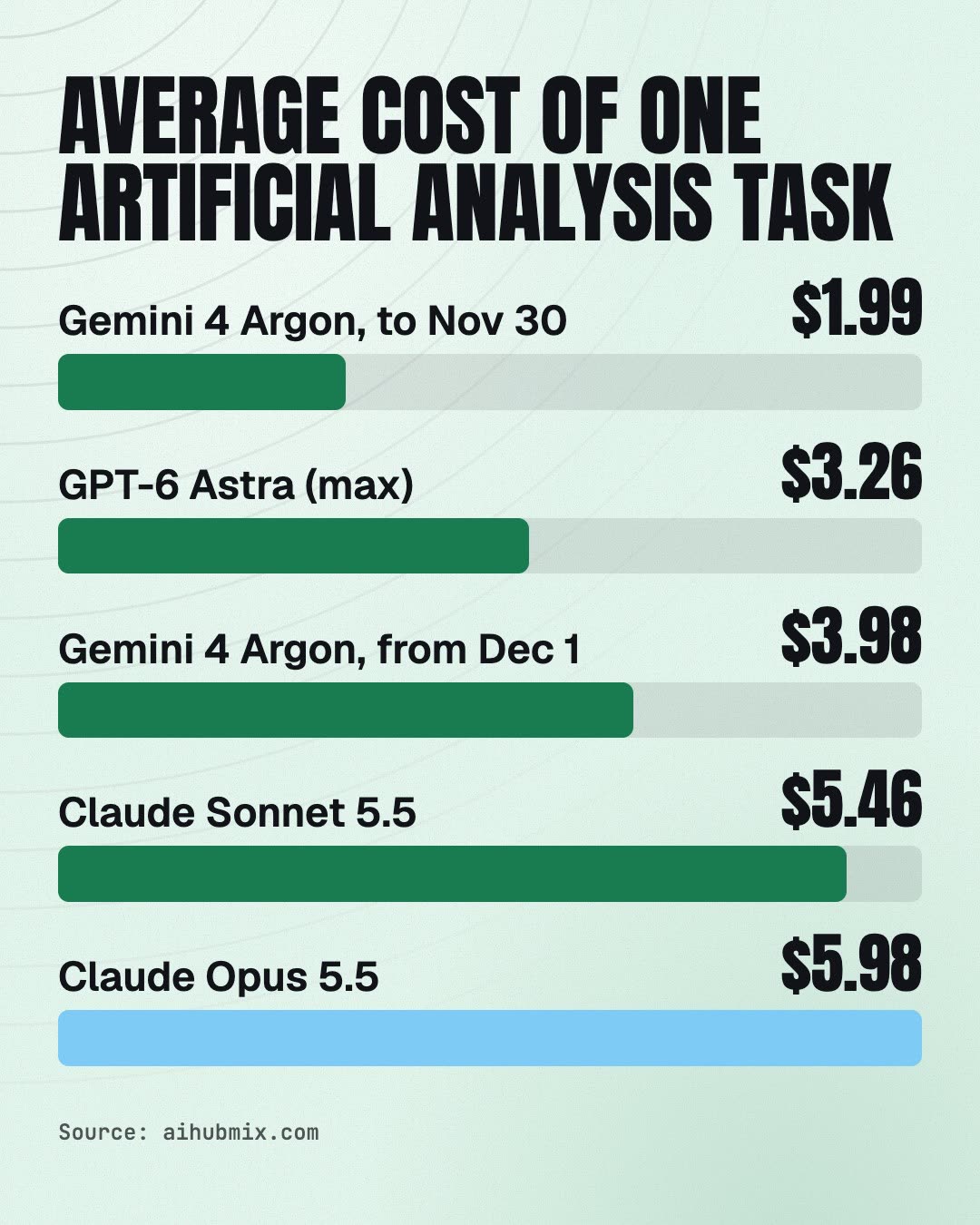
A low price per token doesn't make a task cheap. Argon writes a lot: about 62k output tokens per Artificial Analysis task, roughly 2.3 times as many as GPT-6 Astra (AIHubMix, citing Artificial Analysis).
Artificial Analysis measured $1.99 per task at the intro price and $3.98 at the December price. GPT-6 Astra costs $3.26 for the same score. Astra lists at $10 / $50 per token, yet from December 1 Argon costs about 1.2 times as much per task.
Against Claude it goes the other way. At December prices Argon's $3.98 per task compares with $5.46 for Claude Sonnet 5.5 and $5.98 for Claude Opus 5.5, although both Claude models score higher. On the Vals Index at $4 / $20, Argon averages $15.68 per test, against $21.34 for Sonnet 5.5 and $32.14 for Opus 5.5 (ActuIA).
Two caveats. All of these numbers were measured at the high thinking level. Argon defaults to medium, and no tester has published cost or accuracy at low or medium. Also, testers measure differently, so compare models within one tester's results, not across them.
Three worked examples: what one task costs before and after
The token counts below are illustrative, not measured. Replace them with the counts from the usage field of your own responses. All the math uses Google's listed rates.
Support bot
Each reply has a 5,000-token shared prefix (system prompt plus help docs, cached), 1,000 new input tokens and 1,500 thinking and output tokens. Today that's $0.0005 + $0.002 + $0.015, about $0.0175 per reply. After December 1 it's about $0.035. At 10,000 replies a month, the bill goes from about $175 to $350. Without a cache hit it's 6,000 × $4/M + 1,500 × $20/M, about $0.054 per reply or $540 a month. Most of the cost is output and thinking, and caching saves about a third.
Coding agent
One task makes 30 model calls. Each call has a 40,000-token context (35,000 cached, 5,000 new) and writes 3,000 tokens. After December 1, each call costs $0.007 + $0.02 + $0.06 = $0.087, so the task comes to about $2.61 (about $1.31 today). If the prefix breaks and nothing is cached, each call costs about $0.22 and the task about $6.60. On Flex at half price, the cached version drops back to about $1.31. For agents, a stable cached prefix matters more than anything else.
Batch summariser
Picture 10,000 documents a day, each with 8,000 input tokens and 800 output tokens. On standard after December 1 that's $0.032 + $0.016 = $0.048 per document, about $480 a day. On Batch it's about $240 a day, which is what standard costs today. If the work can wait, moving it to Batch cancels the increase.
If you use Search grounding, add $14 per 1,000 requests beyond the 5,000 free each month. Remember the cap of 1,500 requests a day too.
Four moves to test before November 30
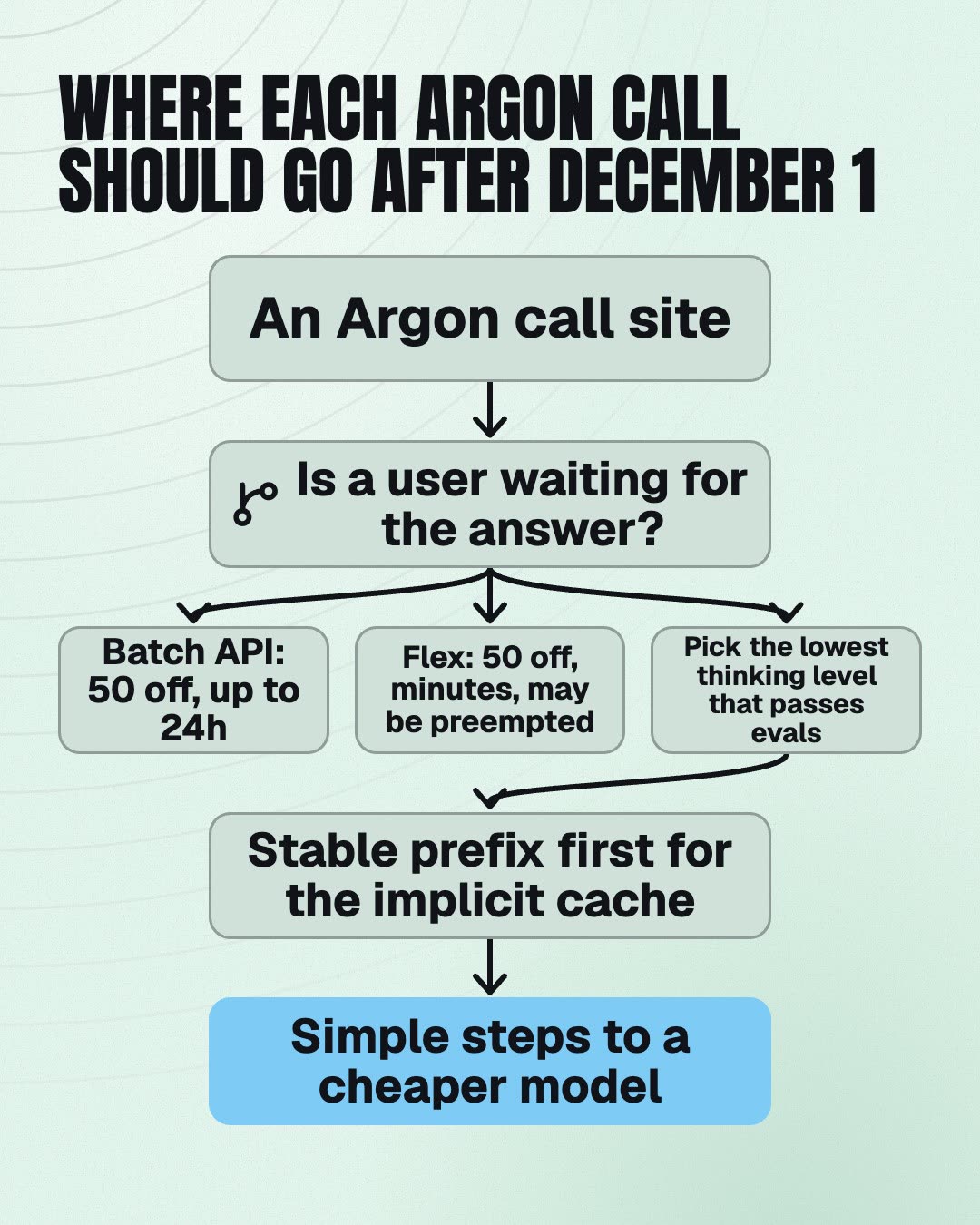
1. Move work that can wait to Batch or Flex
Batch is asynchronous and costs 50% of standard. It accepts in-line requests or a JSONL file of up to 2GB, with a target turnaround of 24 hours. Flex is synchronous, also at a 50% discount, and runs on off-peak capacity. It targets 1–15 minutes, but requests may be preempted during traffic spikes. Google lists multi-step agentic workflows and offline evaluations as good fits for Flex.
2. Lower the thinking level instead of setting a small cap
Argon has three thinking levels: low, medium (the default) and high. Google's model docs put it simply:
Run your evaluations at all three levels, then pick the lowest level that meets your quality bar.
Google, Gemini 4 Argon docs
Don't save money with a tight max_output_tokens. It's a hard limit on thinking and output together. If a response hits it, the request ends incomplete and you still pay for the thinking tokens (AIHubMix). Google advises apps with caps below 32K to raise them to at least 32,768.
3. Put the shared prefix first to get implicit cache hits
Argon has no explicit caching, so you can't pin a cache yourself. Implicit caching is on by default in the Gemini API for prompts of at least 4,096 tokens. ActuIA reads the Google Cloud guide as 6,144 tokens, so check your channel. Repeated prefixes get a 95% discount.
- Put the system prompt, tool definitions and documents first.
- Keep that prefix byte-for-byte identical across calls: no timestamps or per-user details inside it.
- Put the new message last.
- Check the cached-token count in the usage field to confirm you're getting hits.
If you reorder the prompt between turns, cached input is billed at the full price again. As the coding agent example shows, that can more than double the cost.
4. Benchmark one alternative model on your own tasks
Send extraction, classification and formatting to Gemini 3.8 Flash ($0.75 / $3.75 until December 31, then $1.50 / $7.50), or test one other frontier model. Run 50–100 real tasks and measure cost per task and quality. List prices won't tell you which is cheaper.
One more tip from AIHubMix: when Argon declines to answer, send the question to a person or a cheaper model. Don't retry on Argon. A declined answer still bills its input and thinking tokens, and a retry pays for them again.
Limits and open questions
- No low or medium numbers. Every independent cost-per-task figure was measured at high thinking. Your real cost at medium is unknown until you measure it.
- Long outputs re-read the context. Long responses are generated in hops, and each hop reads the prompt plus everything written so far as input. In the example on Google's Long decode page, a 1,000-token prompt that produces 200,000 tokens reports about 397,000 input tokens.
- Cache thresholds differ by channel. It's 4,096 tokens in the Gemini API docs and 6,144 in ActuIA's reading of the Google Cloud guide.
- The Google Cloud promo works differently. There, the promo is paid as credits equal to 50% of net spend, not as a lower unit price. Check your invoices and billing exports.
- Resellers. AIHubMix charges $2 / $10 today and hasn't said whether that changes on December 1.
- Grounding on Batch. The Batch tab of the pricing page has no grounding price rows, only a footnote saying Search queries are charged individually. Check your bill if you ground Batch requests.
What we would do this month
Write the December budget at $4 / $20 now. Treat the intro rate as a few weeks of discount, not something to plan around. Then:
- This week: pull token counts from the usage field for your top three call sites, including thinking and cached tokens. Price each one at December rates: uncached input × input rate + cached input × cache rate + output × output rate.
- Next week: test low against medium thinking on your own tasks, and fix the prompt order so the prefix stays stable. Move offline jobs to Batch and background agent steps to Flex.
- Before the 30th: run one alternative model on the same tasks and decide for each call site, not for the whole app. Keep Argon for the hard reasoning steps.
For many teams, these moves will bring the December bill close to today's. The only way to know is to measure your own tasks. This post is for information only and is not financial advice.
We'll keep tracking AI price changes and what they mean for small teams. Get them in our newsletter.