
In Moneypenny's small business call report, 69% of callers who reached voicemail hung up instead of leaving a message. Moneypenny sells answering services, so it has a stake in that number. Still, the math is hard to ignore: of 100 callers who hit voicemail, about 69 leave nothing, and your callback reaches only the other 31.
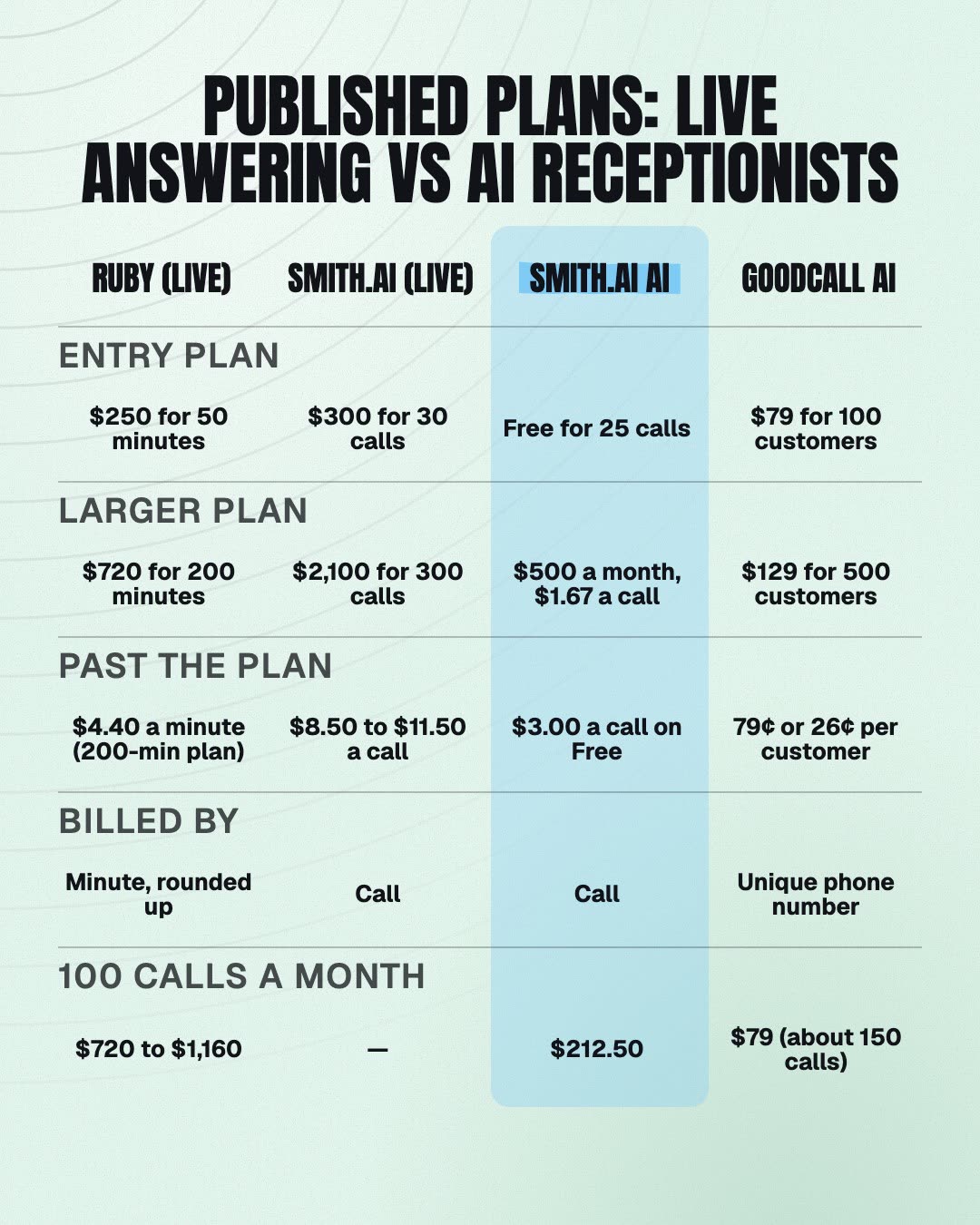
So you want calls answered while you work. There are three ways to do it: voicemail with a callback, a human answering service, or an AI receptionist. The catch is that each one bills in a different unit: minutes, calls or unique phone numbers. That's why headline prices can't be compared directly. We use one yardstick in this article: the cost per 100 calls a month.
Human answering services: per minute (Ruby) or per call (Smith.ai)
Ruby bills per receptionist minute. According to NextPhone's breakdown of Ruby's pricing, plans run from $250 a month for 50 minutes to $1,725 for 500 minutes, with $720 for 200 minutes labelled most popular.
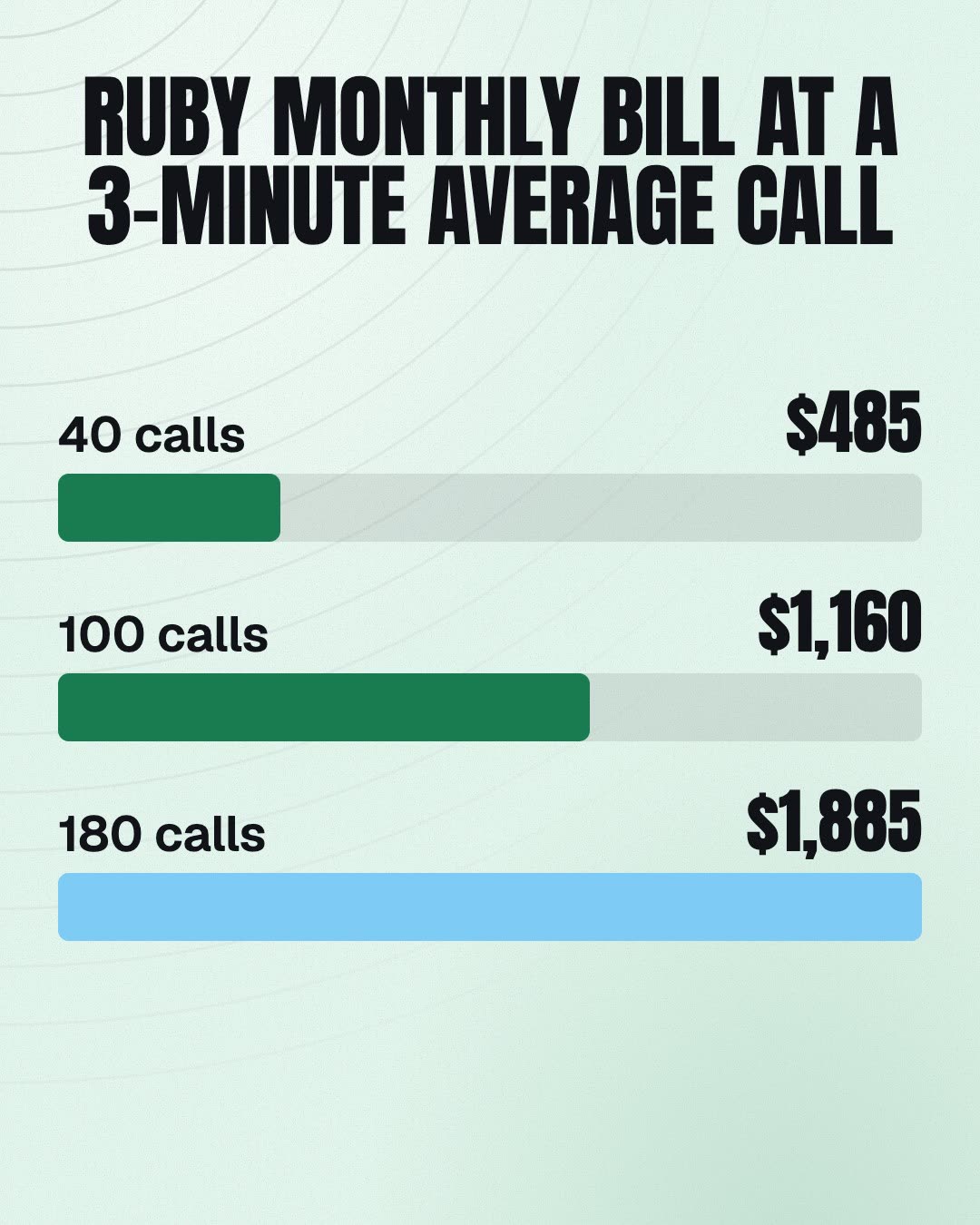
Ruby says a typical call uses about 2 minutes, so 100 calls fit the $720 plan. At 3 minutes, the same 100 calls cost $1,160. Your real average call length decides the bill, not the plan name.
The fine print moves the number further:
- Every call rounds up to the next 60 seconds.
- Hold time and after-call work count as minutes.
- Paying by credit card adds 3%.
- An upgrade applies to the current billing period and at least the next two, so one busy month can lock you into three expensive ones.
Smith.ai's live receptionists bill per call. The official pricing page lists $300 a month for 30 calls, $810 for 90 and $2,100 for 300. Extra calls cost $11.50, $10.50 and $8.50 on those plans.
For 100 calls: the $810 plan plus 10 extra calls at $10.50 comes to $915. Booking appointments costs $1.50 a call, and Smith.ai's help article says add-ons are charged on all calls, not only the ones that use them (NextPhone). That's another $150, so about $1,065.
What you pay for is a real person: judgment on unusual calls and a human voice for work built on trust. For some businesses that's worth several times the price of AI.
AI receptionists: from $49 to $500, billed in four different ways
Smith.ai AI Receptionist (pricing) is free for 25 calls a month, then $3.00 a call. Pro starts at $150 a month at $2.00 a call, and Enterprise at $500 a month at $1.67 a call. At 100 calls, NextPhone puts the bill at $212.50. A handoff to a live Smith.ai agent costs $3, so if 20 of those calls reach a person, it's $272.50.
Goodcall (pricing) bills per unique customer: one phone number, once a month. If the same person calls five times in March, that's one customer. Spam and wrong numbers don't count.
- Starter: $79 for 100 unique customers (about 150 calls), then 79¢ each.
- Growth: $129 for 500 unique customers (about 750 calls), then 26¢ each.
- Scale: $299 for 2,000 unique customers (about 3,000 calls), then 15¢ each.
So 100 calls cost $79 on Starter.
Rosie (pricing) bills by minutes. Professional is $49 a month for 250 minutes, with message taking and appointment links sent by text. Booking appointments and routing calls to the right person come with Scale at $149. At 100 calls that's $49 if a texted link is enough, or $149 if the AI must book.
A warning about pricing roundups: Synthflow's own page now says it's sold only as an annual enterprise agreement, with no free plan, no trial and no per-minute rate. Prices change, so if a guide quotes a monthly plan, check the vendor's page before you budget.
What goes wrong: invented answers, booking errors and the wrong tone
Cheap answers aren't worth much if they're wrong. Here's what the sources report.
- Wrong answers. JustCall, which sells an AI voice agent, says the usual cause is a knowledge base that's out of date, too thin or poorly mapped to real questions. The AI then quotes old hours or an old policy with full confidence.
- Mishearing becomes a booking error. JustCall's example: the bot hears “water heater” as “boiler”, books the wrong technician, and the job needs a second visit.
- Double bookings. OnceHub, which sells scheduling tools, points out that when an AI checks a calendar through an outside API, there's a gap between offering a slot and saving it. Someone else can take the slot in that gap.
- Tone. In Lilach Bullock's 30-day test, the AI logged 118 calls and got 4 wrong. The bigger problem: a referred prospect wasn't sure she'd reached a real business or a call centre and nearly didn't follow up. Bullock fixed it by rewriting the script in her own words.
An honest limit: we found no large, independent study of AI receptionist error rates. The evidence is vendor pages and single tests. Treat any accuracy claim as something to check on your own calls.
Try this: set it up in an afternoon and test with five real calls
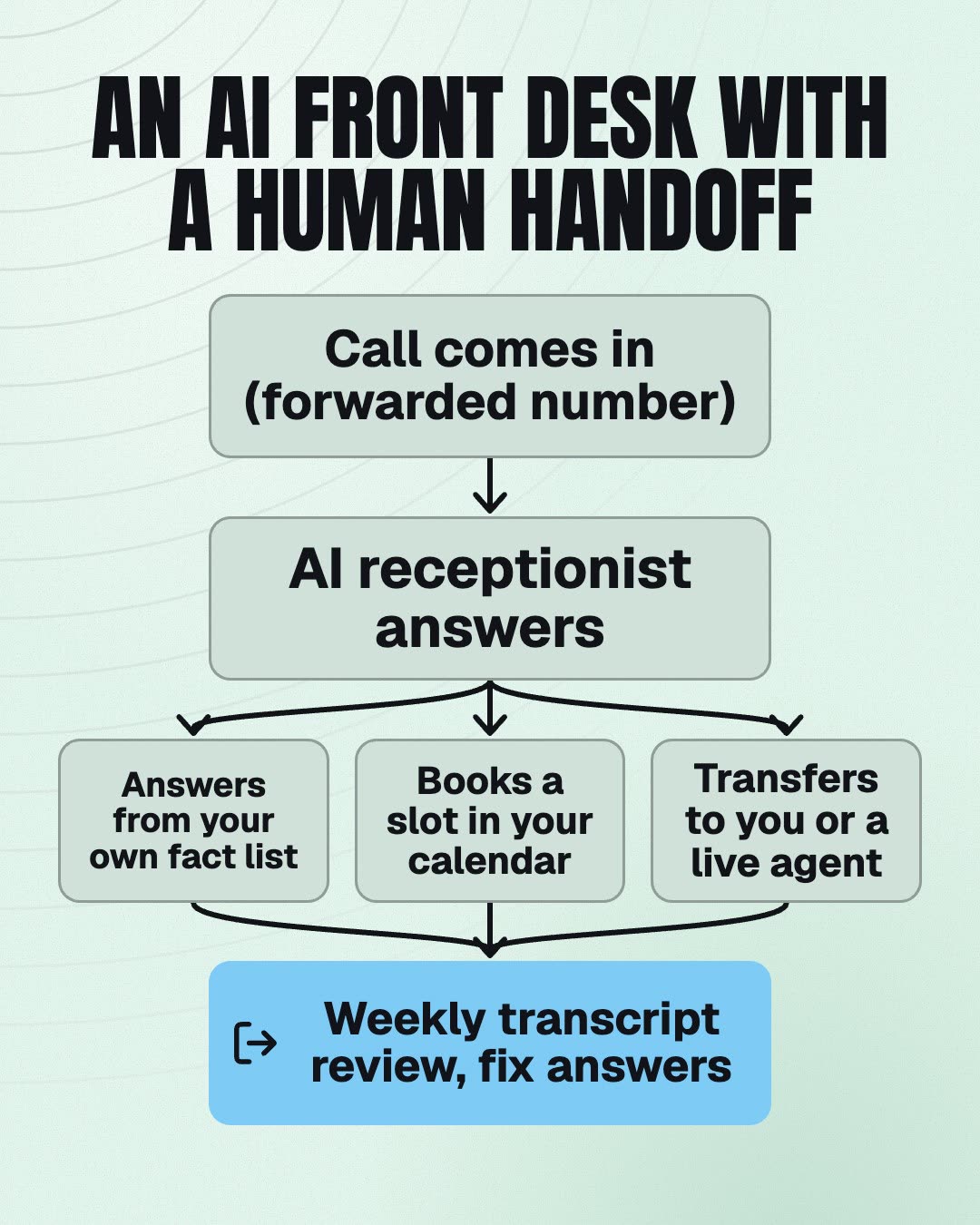
- Forward your number, don't port it. Start with after-hours calls, where a mistake costs least.
- Write the facts yourself: hours, services, price ranges, service area and what you don't do. Keep one service list that matches your booking calendar exactly.
- Set hard handoff rules. Words like “urgent” or “complaint”, or a known client's name, always go to your mobile or a live agent.
- Run five test calls before going live: your most common question, a new customer, an upset caller, a bad line or strong accent, and a request for something you don't offer. Listen to the recordings.
- Read transcripts every week for the first month, and update answers the same day your hours or prices change.
What we would choose at 50, 300 and 1,000 calls a month
This is our reasoning from the published prices, not a client result.
50 calls a month: a solo tradesperson or a small clinic
An AI receptionist on a flat or capped plan, with transfers to your mobile: Goodcall Starter at $79, Rosie at $49–$149, or Smith.ai Free at about $75 (25 extra calls × $3). For comparison, Smith.ai's live Starter plus 20 extra calls is $530. If your business sells personal trust, a human service can still be worth it at this volume.
300 calls a month: a busy shop or a multi-chair clinic
AI handles most calls and a person handles the hard ones. Goodcall Growth at $129 covers about 750 calls. Smith.ai's AI Pro is $500 for 300 calls, and any AI plan can hand a call to a live Smith.ai agent for $3 when intake matters. All-human on Smith.ai is $2,100 plus add-ons.
1,000 calls a month: several locations
Per-call human service stops fitting the budget: Smith.ai's live Pro plus 700 extra calls is $8,050 before add-ons. Goodcall Scale at $299 covers about 3,000 calls. At this volume, also price an in-house receptionist: about $54,400 a year fully loaded, per OnceHub, and one person covers 40 of the 168 hours in a week. Our pick is an AI front line with your own staff taking transfers at peak hours. If several systems need to talk to each other, a custom setup starts to make sense.
Whichever you choose, voicemail should be the last fallback, not the plan.
Pick by your own numbers
Three numbers decide it: your calls a month, your average call length and how many callers need a person. Pull them from last month's phone log before you talk to any vendor. Then run the 100-call math above on your own volume, with overage and per-call add-ons included.
Want an AI receptionist connected to your calendar, CRM and handoff rules, built and tested on your real calls? Work with us and we'll help you set it up.