
In November 2023, marketer Jake Ward posted on X: "We pulled off an SEO heist that stole 3.6M total traffic from a competitor." By August 2024, Ahrefs estimated that the site behind that brag had lost 99.52% of its organic traffic.
If you run a small company, you've probably had the thought: let AI write 50 posts a month and the traffic will come. Public cases keep showing the same curve instead. A fast rise, then a collapse. Below we go through the numbers, what Google's rules actually say, and a way to use ChatGPT or Claude on your blog without putting the whole site at risk.
The heist that worked, until it didn't
Ward's thread laid out a three-step recipe:
- Export a competitor's sitemap.
- Turn its list of URLs into article titles.
- Create 1,800 articles from those titles at scale using AI.
He said the team published the 1,800 articles "in a few hours" and claimed 490K monthly traffic and 13K keywords on page 1 of Google. Those numbers are self-reported. Nobody outside the company could check them.
The client was Causal, a startup that makes business planning software. The target was Exceljet, an Excel tutorial site. According to HubSpot, Dave and Lisa Bruns built Exceljet's library over eleven years, and an Excel expert tests and verifies every article. Ward's copies were published without any oversight from a human expert.
The curve after the brag: what Ahrefs measured
In its list of the biggest traffic losers in SaaS, Ahrefs compared estimated monthly organic traffic for 1,600 SaaS companies in August 2023 and August 2024. Causal came first:
- Monthly organic traffic: 307,158 → 1,485 (-99.52%).
- Organic keywords: 222,777 → 4,023 (-98.19%).
- Keywords in the top 3: 8,969 → 26 (-99.71%).
Ahrefs puts the loss down to a Google manual penalty. The AI posts now 301-redirect to the company's blog homepage.
Two caveats. These are Ahrefs estimates, not Causal's own analytics; as Ahrefs puts it, only the company knows its real traffic. And the slide started earlier: HubSpot's Aja Frost said that after Ward's post went viral, the site's organic traffic fell 42%.
Here's why it matters: the drop didn't stop at the 1,800 copied posts. Keywords, rankings and traffic across the whole site went with them. The blog had to start over.
It wasn't just one startup: the March 2024 manual actions
In March 2024, Google strengthened its policy on scaled content abuse. It now covers "producing content at scale to boost search ranking — whether automation, humans or a combination are involved." Google said searchers would see 45% less low-quality, unoriginal content in results after the rollout.
Search Engine Journal collected what happened next:
- Ian Nuttall tracked 49,345 sites. 837 of them, about 1.7%, were removed from the index completely. Together they had over 20.7 million organic visits a month before the manual action.
- Originality.ai reported that 100% of the affected sites it checked showed signs of AI content, and half had 90–100% AI posts. Originality.ai sells AI detection, and we don't know how the sample was chosen, so treat this as a signal, not proof.
- Some sites came back. Nuttall reran his script and found 21 of the deindexed sites with pages indexed again.
So the picture isn't simply "AI means banned." But sites built mostly from mass-produced pages were the ones that got hit.
The controlled test: 2,000 AI articles on 20 new domains for 16 months
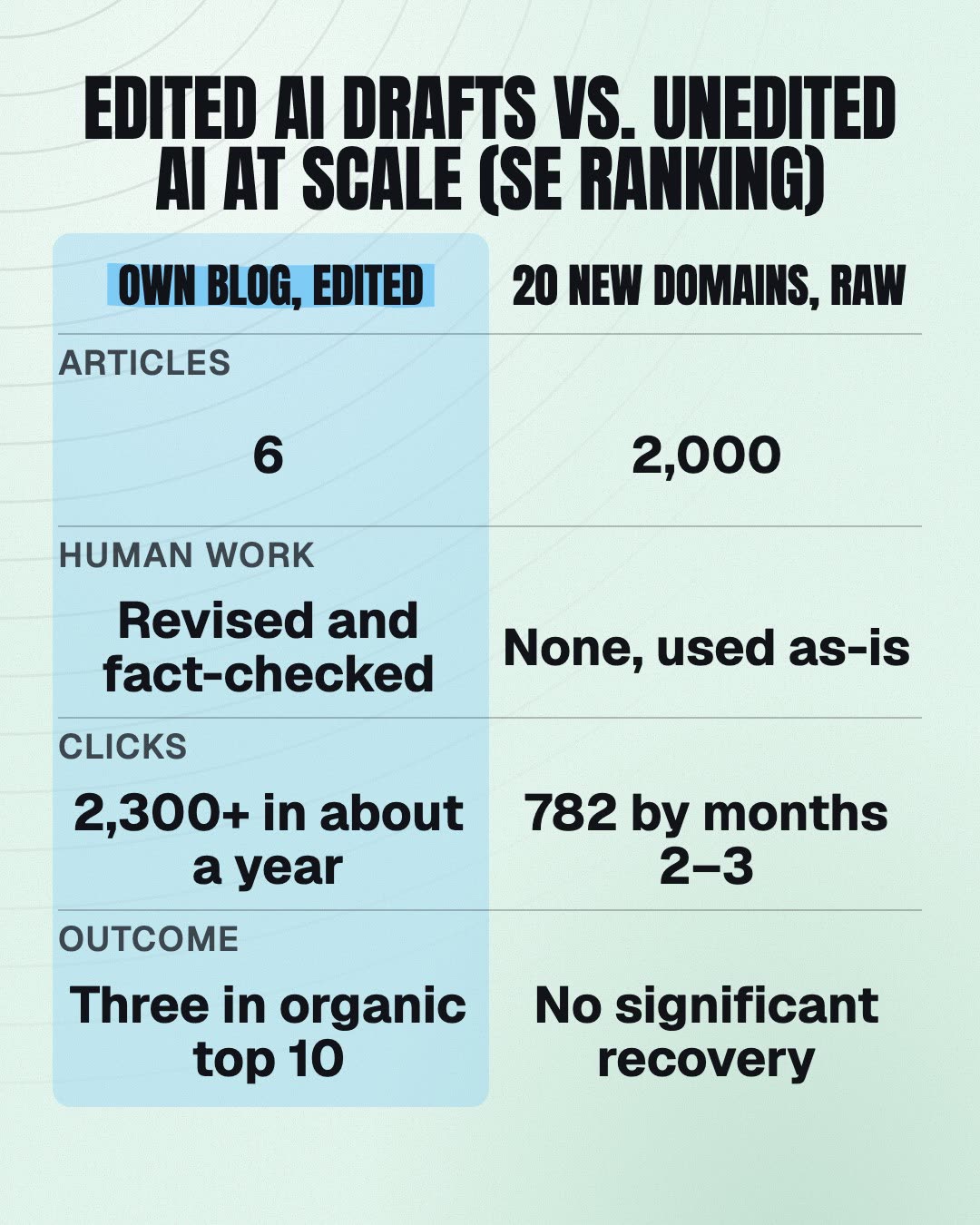
The cleanest public test we found comes from SE Ranking, also covered by Search Engine Land. In November 2024 it launched 20 brand-new websites and put 100 one-click AI articles on each. No edits, no backlinks, no images.
- Month 1: Google indexed about 71% of the pages. That brought 122K+ impressions and 244 clicks.
- Months 2–3: impressions passed 526K and clicks more than tripled, from 244 to 782, with no outside help.
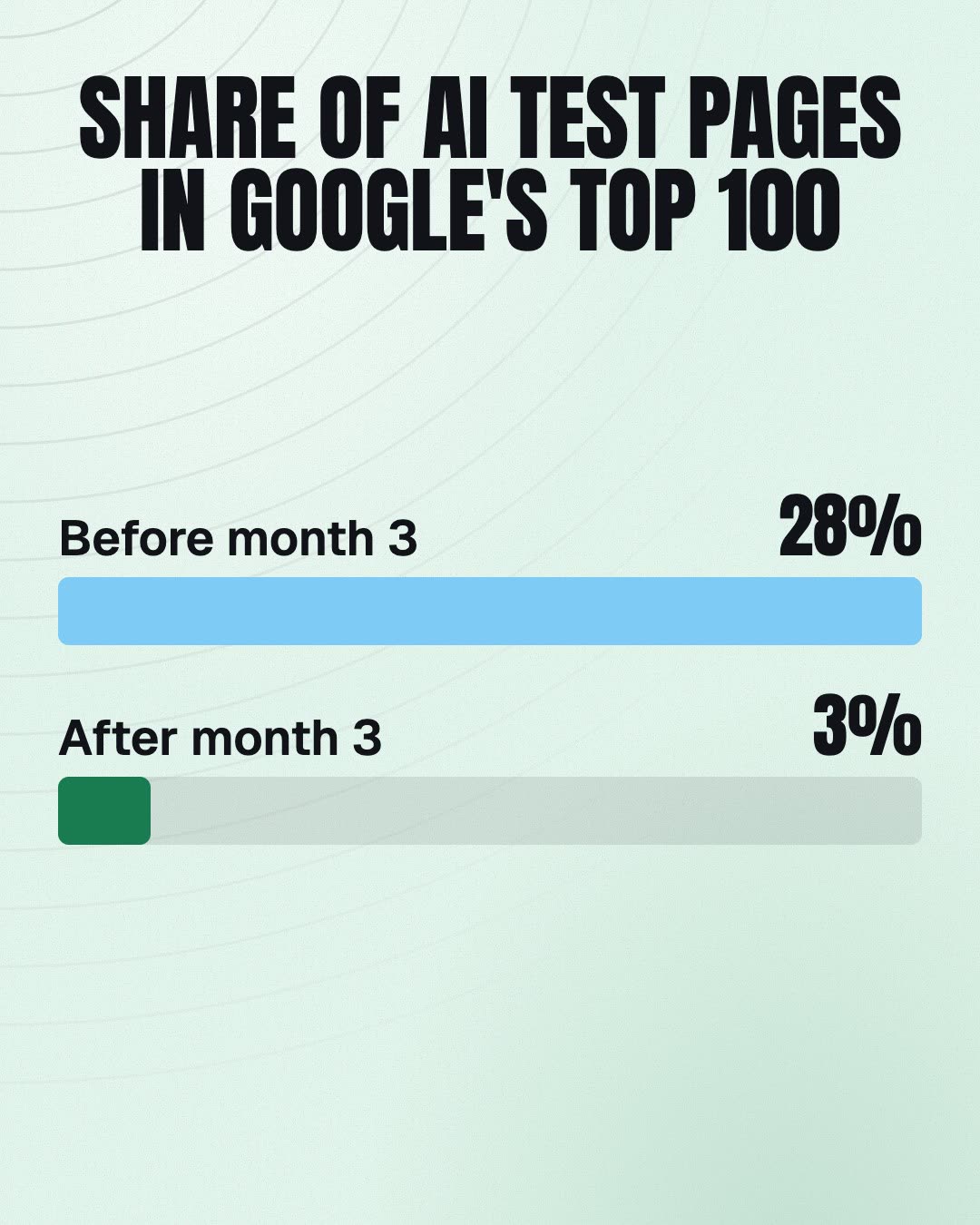
- Around month 3: the share of pages in the top 100 results fell from 28% to 3%.
- Month 16: no significant recovery. Most sites settled into low visibility and little traffic.
Most pages stayed indexed, but almost nobody could find them. Indexed isn't the same as visible.
The same company also tried the other way on its own blog. Six AI-assisted articles that people outlined, edited and fact-checked got almost 555K impressions and 2,300+ clicks between June 2024 and July 2025, and three rank in the top 10. Our reading: the difference came from the human work and an established domain, not from the AI.
What Google actually says about AI content
Google doesn't punish AI as such. Its 2023 guidance gives a blunt test: "If you see AI as an essential way to help you produce content that is helpful and original, it might be useful to consider. If you see AI as an inexpensive, easy way to game search engine rankings, then no."
Its current guidance on generative AI content draws the line in three points:
- Useful: AI can help you research a topic and add structure to original content.
- The line: "using generative AI tools or other similar tools to generate many pages without adding value for users may violate" the scaled content abuse policy.
- The duty: "manually factcheck and review all AI-generated content for accuracy and trustworthiness before publishing", including titles, meta descriptions and alt text.
Why commodity how-tos were the easy target, and why your blog shouldn't be one
HubSpot's Aja Frost explains why the copying worked for a while. Exceljet's articles, like "XLOOKUP vs VLOOKUP" and "How to concatenate in Excel", are "fairly commodified." They have clear answers and don't need a point of view.
That's also what makes this kind of post easy to replace. If AI can write your article from its title, so can anyone else.
For a small company, the ground you can defend is what a model can't know: your customers' questions, your numbers, your mistakes, your screenshots, your opinion. Rory Hope from HubSpot is direct about the other path. Scraped, mass-produced posts "will be unhelpful, and your entire site will eventually be hit, either with a site-wide performance dampener or a manual penalty."
Try this: an AI blog workflow for a small team
- First: a person picks the topic from real customer questions, sales calls or support tickets, not from a competitor's sitemap.
- Next: use ChatGPT or Claude for research and an outline. Ask for sources, then open and read them yourself.
- Then: let AI write a rough draft. The person who knows the subject adds what only they know: a real example, a number from your own work, a screenshot, a clear opinion.
- Then: check every fact, name and number against its source, plus the title, meta description and alt text, as Google's guidance asks.
- Last: publish at a pace you can review. Add a byline, and say how AI was used when readers would reasonably want to know.
Then watch Search Console. A fast early climb doesn't prove the approach works. In SE Ranking's test, the climb looked great for two months, and the collapse came around month three.
Open questions, and what we would do
- No published threshold. Google doesn't say how much editing counts as "adding value". It's a judgment call, and updates keep moving the line.
- Estimates, not analytics. The traffic numbers in these cases are third-party estimates or self-reported. Only the site owners know the real figures.
- Recovery is unclear. Some deindexed sites came back within days. SE Ranking's sites didn't recover in 16 months.
What we would do: treat AI as a fast research assistant and first-draft writer, never as the author. Keep fewer pages, and make sure each one has something only your team could write. A few strong posts a month beat 50 you never read.
Want more practical guides on using AI in real work? Start at /learn.