
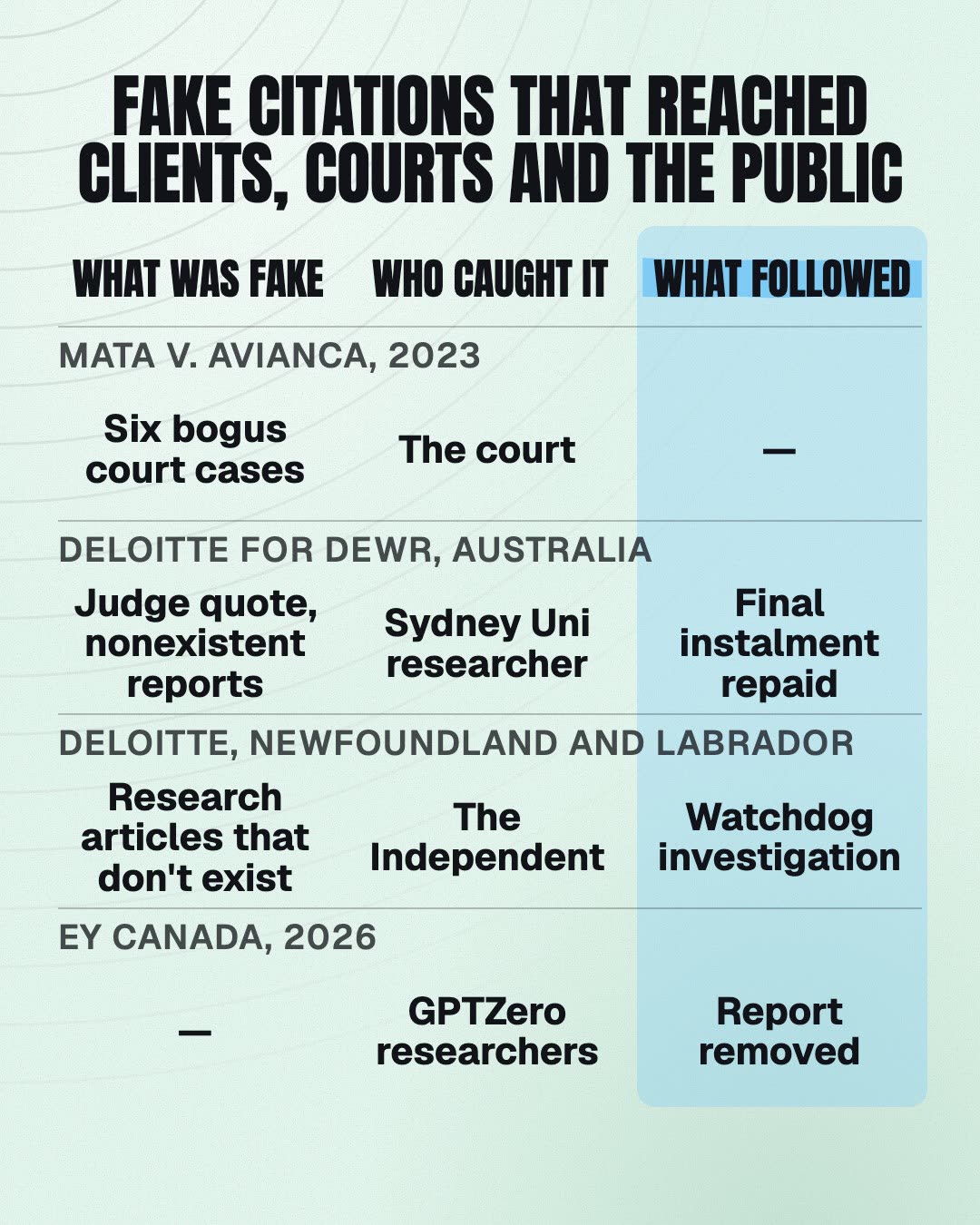
A report Deloitte wrote for Australia's Department of Employment and Workplace Relations (DEWR) quoted a Federal Court judgment that doesn't say those words. It also cited reports that their supposed authors never wrote. The client paid AU$440,000 for it, and Deloitte agreed to repay the final instalment.
It wasn't a one-off. Since then, fake citations have turned up in another Deloitte report in Canada and in an EY Canada report. If you hand clients reports, audits, research or proposals drafted with AI, the risk is the same for you: a source that doesn't exist reaching the client with your name on the cover.
Below we cover what happened, why review keeps missing it, what lawyers learned in 2023, and a check you can run on any document in an afternoon.
What happened: an AU$440,000 report with a judge's quote nobody said
The job was an independent assurance review of the Targeted Compliance Framework, the government's IT-driven system that penalises welfare recipients who miss obligations such as job search appointments. Deloitte did the work from December 2024 to June 2025. The 237-page report was published in July.
Chris Rudge, a University of Sydney researcher of health and welfare law, read it and spotted a book he'd never heard of. He told AP he "instantaneously knew it was either hallucinated by AI or the world's best kept secret." He found up to 20 errors in the first version.
Per The Register, the fake material included:
- Citations to imaginary reports by University of Sydney law professor Lisa Burton Crawford and Lund University's Björn Regnell.
- A fictional extract from the robo-debt case Amato v Commonwealth.
- A fabricated quote from nonexistent paragraphs 25 and 26 of a judgment by Justice Jennifer Davies, whom the report called "Justice Davis".
A corrected version went up in October 2025. It strips out more than a dozen bogus references and footnotes, and it's the first version whose methodology discloses "a generative AI large language model (Azure OpenAI GPT-4o) based tool chain." DEWR says the substance is retained and the recommendations haven't changed. The page was updated again on 3 February 2026 "to address identified corrections."
Deloitte told AP the matter "has been resolved directly with the client" and didn't say whether AI caused the errors. Senator Barbara Pocock said the firm should refund the entire AU$440,000.
Not a one-off: Deloitte Canada, EY Canada and a New York court
In Newfoundland and Labrador, a 526-page Deloitte Health Human Resources Plan that cost $1.6 million cited research that doesn't exist. Deloitte said it used AI "to support a small number of research citations" and was making corrections that "do not impact the report findings." The accounting watchdog CPANL has opened an investigation.
In May 2026, EY Canada removed a cybersecurity report from its website after GPTZero researchers found references to webpages that don't exist and citations to a McKinsey report that appears never to have been published. EY said the study wasn't connected to client work. The same article notes that Sullivan & Cromwell apologised to a New York court over inaccurate citations in a filing.
These firms advise clients on AI governance. If their review can miss a fake footnote, a five-person agency's review can too.
Why fake sources slip through review
They look right. A model produces a plausible author, a fitting title and a page number. Rudge told Computerworld the works were "almost too perfectly tailored and too bespoke for the text, and that was a red flag." Real sources rarely fit your argument that neatly.
Reviewers read the argument, not the footnotes. Lawyer Monthly describes the pattern: managers skim the final version and assume somebody else checked the sources, because checking every citation by hand removes much of the speed AI promised.
The catch came from outside. Rudge said one of the easiest tells was that he knew the authors personally. Your client, or their lawyer, may be that person.
Late disclosure makes it worse. Forrester's Sam Higgins said Deloitte's "post-hoc disclosure sets a poor precedent for responsible AI use in government engagements." Saying upfront that you used AI costs less than admitting it later.
Lawyers learned this in 2023: Mata v. Avianca
In a personal injury case against the airline Avianca, a brief built on ChatGPT research cited cases that weren't real. Judge P. Kevin Castel wrote that "six of the submitted cases appear to be bogus judicial decisions with bogus quotes and bogus internal citations" (Legal Dive).
He set the penalty at $5,000. In his ruling he said the lawyers "abandoned their responsibilities" and "continued to stand by the fake opinions after judicial orders called their existence into question." They also had to send his opinion to the judges the fake decisions were credited to. "Many harms flow from the submission of fake opinions," Castel wrote.
The lesson for anyone who delivers documents: the fabrication itself is the failure, and defending it makes things worse. Courts settled that three years ago. Consulting clients and watchdogs are now taking the same line.
The one-afternoon check: run it before you send any document
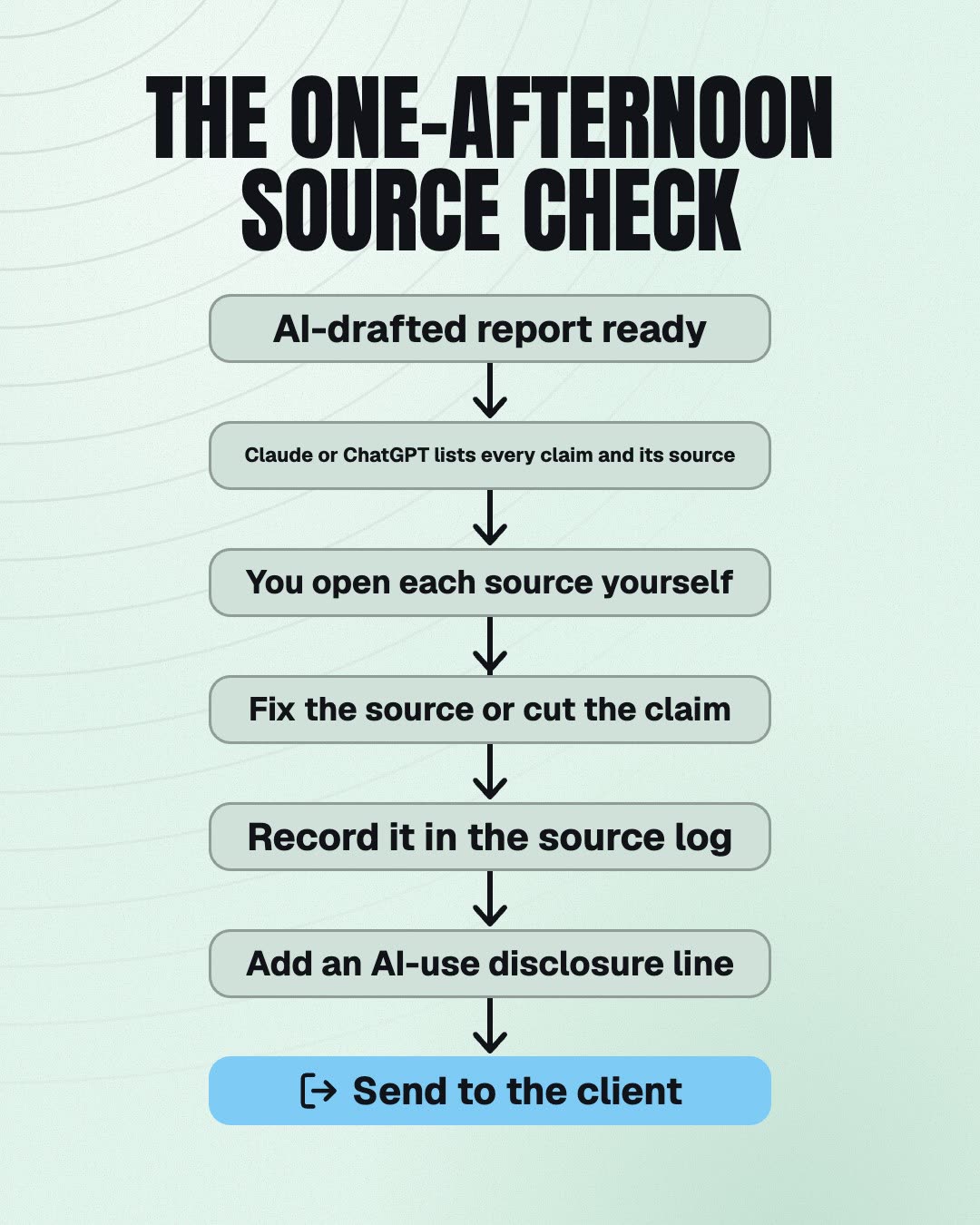
You don't need special software for this, just Claude or ChatGPT, a browser and a spreadsheet. The one rule: the model builds the list, you do the checking.
- List every claim. Paste the draft into Claude or ChatGPT and ask for a table of every factual claim, number and quote, with the source the draft gives for it and the page or section. Tell it to mark any claim that has no source.
- Open every source yourself. Click each link, find each paper, book or case. Check three things: it exists, the author is real, and it says what your draft says. Search quotes word for word. Never ask the model whether a source is real, because it can confidently invent one again.
- Fix or cut. Swap in a source you've checked, soften the claim or delete it. A claim with no real source doesn't go to the client.
- Keep a source log. Claim, URL, date opened, who checked it. A simple spreadsheet is enough, and if a client asks, you can show the work.
- Add a disclosure line near the start or in the methodology. Deloitte added one only after it was caught.
Here's a prompt for step 1 you can reuse:
List every factual claim, number and quote in the document below as a table with columns: claim, source given in the document, page or section. Do not add sources, do not judge whether sources are real. If a claim has no source, write NO SOURCE.

[paste the draft]
And a disclosure line for step 5: "We used AI tools to help draft and structure this report. Every source and quote was checked by [name] on [date]."
How long it takes: our estimate is about an afternoon for a 30-page report with 40 citations. That's a rough figure, not a measurement, and it depends on how easy your sources are to open. Either way it costs far less than a refund or a watchdog complaint.
Limits and open questions
- It checks sources, not thinking. The check proves a source exists and says what you claim. It doesn't prove your analysis is right. Rudge argues that any project where AI did most of the knowledge work still needs a subject-matter expert to sense-check it at the end.
- Paywalls and court records take longer. Budget time for them, or cite only what you can actually open.
- Contracts are catching up. Analysts quoted by Computerworld advise buyers to ask explicitly about AI involvement, validation steps, human review, source verification and accountability for accuracy before accepting deliverables. Expect these questions in your next RFP and have answers ready.
- Pricing is open. How much should a client pay for AI-assisted work? The Deloitte refund and the Newfoundland complaint suggest clients will start asking.
What we'd do starting this week
- Make the check a rule for every client deliverable, not just the big ones. Fake citations have shown up in a marketing report as well as in government reviews.
- Keep one claim-table prompt and one source-log template that the whole team uses.
- Put the disclosure line in your report template so nobody has to remember it.
AI makes drafting fast. It doesn't move the responsibility for what goes out under your name. An afternoon of opening links is cheap insurance. For more practical guides on using AI in client work, see Learn.