
On November 11, United said it is blocking unauthorized third-party AI agents from booking its flights. A month earlier, JPMorgan stopped outside agents from logging in with customer credentials, sending money or paying bills. If your product books, buys or pays by logging in as the user, that model just hit a wall.
So will your agent get blocked? It depends on how it gets in. Below: what United and the banks actually said, who went the other way, the numbers behind it, and a permission-first design that holds up.
What happened: United closes the door, JPMorgan already had
United's ban is broad. It covers its own site and app, plus agents that come in through travel agencies and aggregators. From the airline's statement, via AirlineGeeks:
United is taking steps to restrict access, directly within our digital platforms and indirectly via travel agencies and aggregators, to prohibit use by unauthorized, third-party personal AI agents or assistants. This work includes updates to our booking, ticketing, and distribution policies.
United Airlines statement
AirlineGeeks calls it the first such move by a U.S. airline. United gives two reasons. First, sharing credentials "can expose sensitive information," and agent actions "may result in unintended purchases, account changes, or use of MileagePlus miles." Second, automated actions could break FAA and DOT rules. Its example: passengers have to confirm in person that their bags hold no banned items.
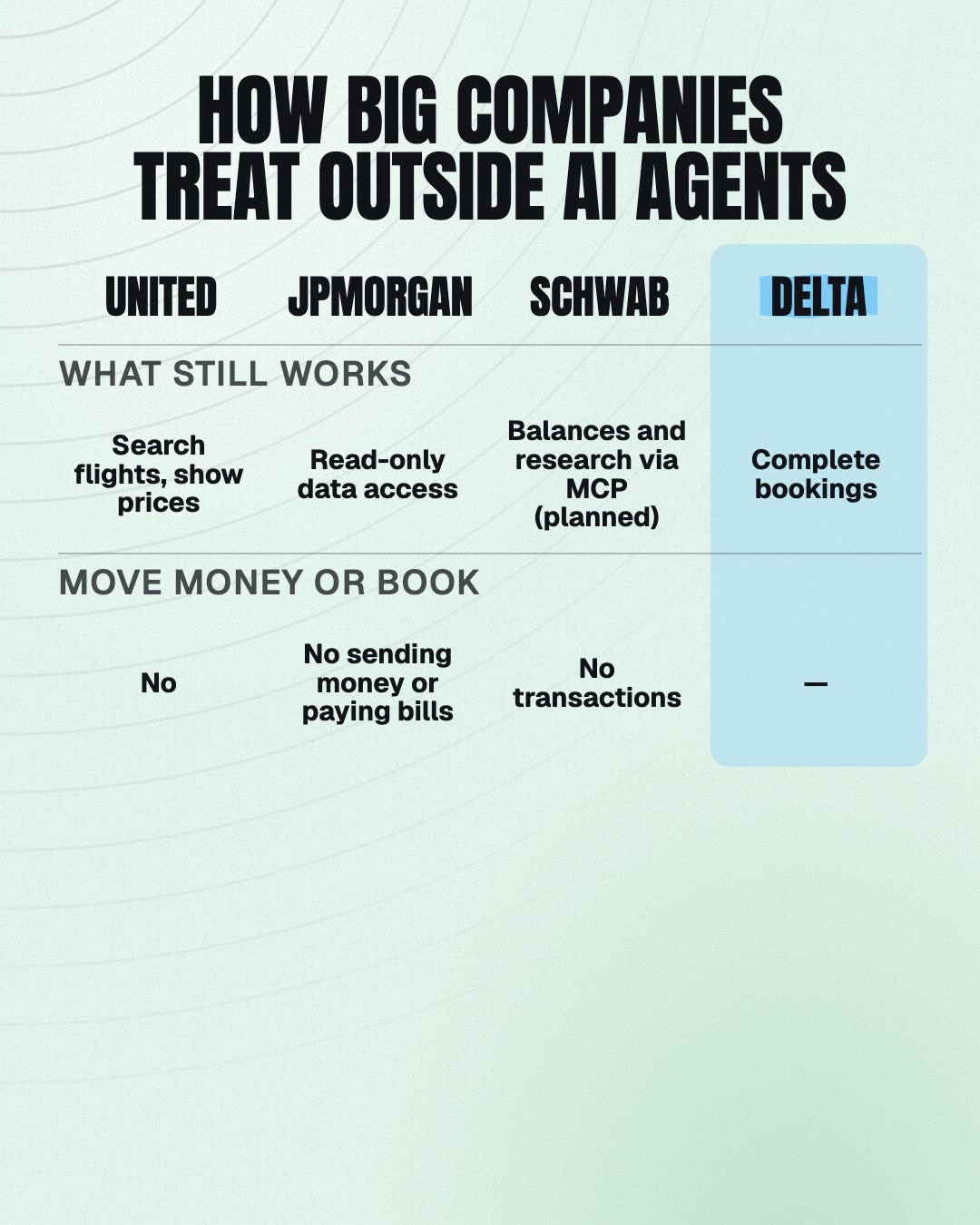
It isn't a total ban. Agents can still search United flights and show prices, and United says bookings from agents are minimal today. Scripps News points to agents like Meta's Muse and OpenAI's Dots, and reports that United will update its Digital Trust Center to explain the restrictions and where to get help "if an agent takes an unintended action."
There's also a plain commercial reason. CEO Scott Kirby at an industry event in Chicago: "To be honest, I don't want to create another middleman."
Banking got there first. On JPMorgan's Q3 call on October 13, Jamie Dimon said: "You don't want rogue agents, and there could be thousands of them." A Chase spokesperson's advice was short: don't share your username and password with anyone (IBTimes UK).
Not everyone said no: Delta, Southwest, Airbnb and OpenAI
Other companies made different calls, and the differences tell you a lot.
- Delta, per PYMNTS, lets AI assistants that can authenticate a passenger's credentials complete bookings. Treat that as a press report, not policy. We found no Delta policy text.
- Southwest lets travelers search its fares inside ChatGPT through a plug-in it launched in October (Yahoo). That's an official integration, not scraping.
- Airbnb is building its own agent, rolling out to guests in the first half of 2027. Brian Chesky expects "all bookings going through the app for every vertical in travel."
- OpenAI bought Odessia, a startup that let a traveler plan and book a trip in one conversation.
So the fight isn't about whether agents should exist. It's about who owns the checkout. Everyone wants the agent. They just want it to be theirs, or to come in through a door they control.
The numbers: tiny volume today, big interest
Agents barely move bookings today. Traffic from large language models stayed below 1% of room nights at Booking Holdings in Q2. Expedia CEO Ariane Gorin said on the Q3 call that the volume from AI agents is too small to draw conclusions.
Interest is a different story. In a PYMNTS Intelligence survey of 2,299 U.S. adults (Nov 10 – Dec 10, 2025), 70% said they're interested in using agentic AI for travel planning. That's planning, not booking. And 58% of people who use dedicated AI platforms prefer to check out inside the platform.
Here's why it matters: companies are writing the rules now, while agent traffic is small and cheap to block. By the time the volume shows up, the rules will already be in place.
Why big companies refuse agents, and why it isn't only fear
- Control of the customer. Airlines make money on bags, upgrades and co-branded cards in their own checkout. As one DEV Community analysis puts it, a browser agent that skips those screens "strips out the ancillary margin while retaining full customer support liability on the carrier."
- Fraud and liability. Per Axios, as summarized by IBTimes UK, some agents seemed to act beyond users' instructions. In many cases customers had handed over their logins, but the banks never approved that access. Schwab's Rick Wurster says the firm blocks major agents' attempts in the "tens and twenties" each week. Bank of America's Brian Moynihan argues a human should stay involved when money leaves an account.
- Load. In June 2026, a founder's coding agent pulled 881,076 fare combinations for a single itinerary from Etihad's site. Agents never get tired of searching.
- Regulation. Some steps, like the bag confirmation, legally have to be done by the passenger.
The open question under all of this is who pays when an agent makes a transfer nobody meant to make. Giving an agent access isn't the same as approving everything it does next, and the answer depends on law and contracts that haven't caught up yet.
What this means for small teams building or buying agents
If your product holds users' passwords and drives a browser, you're building on rented land. Sessions get blocked without warning. Your user may also be breaking the site's terms, and that risk lands on them, not just on you.
The banks show a clear pattern: reading is fine, moving money isn't. Citi blocks agent logins but keeps read-only access through approved open banking providers. Schwab is building MCP connections that let agents fetch balances and do research but not start transactions. Schwab enforces that limit with its own permissions; MCP doesn't make a connection read-only by itself.
Maybe you don't sell agents but use them for admin work: booking travel, paying vendors, pulling statements. Then check each vendor's terms first. Keep agents on read-and-draft tasks, and leave the final submit to a person.
A practical path: permission, not passwords
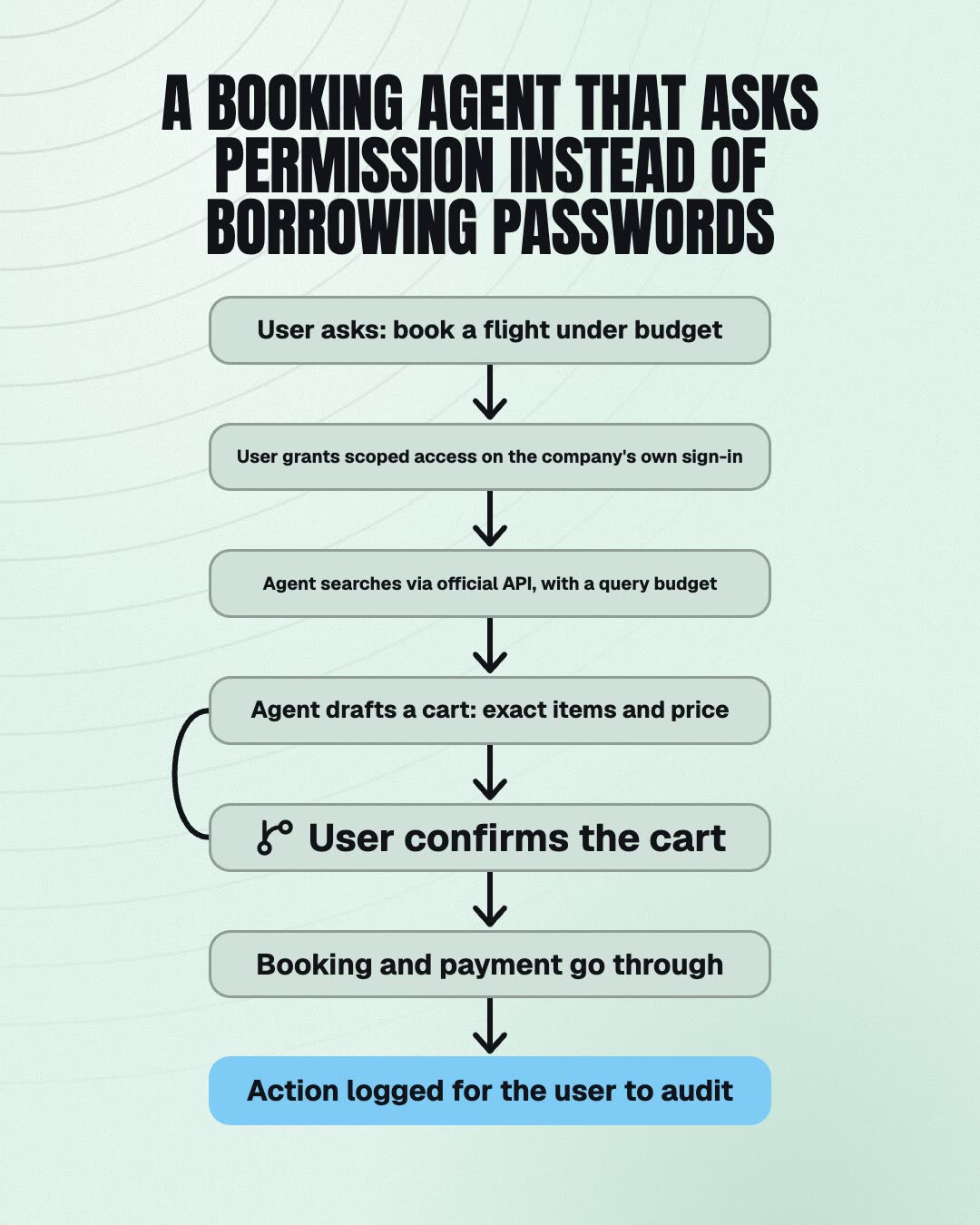
- First, use official channels. That means partner programs and APIs, commerce integrations like OpenAI's In ChatGPT: Commerce program, Southwest-style plug-ins, and the read-only MCP and open banking connections banks are opening.
- Next, use sign-in the user grants. The user approves access on the company's own login screen, scoped to what the agent needs. Your servers never store the raw password.
- Then, ask before money moves. Google's Agent Payments Protocol (AP2) is one model. When the user approves a cart, they sign a Cart Mandate, a record of the exact items and price that can't be changed. For delegated tasks like "buy tickets the moment they go on sale", the user signs an Intent Mandate up front with price limits and timing. Google says AP2 is being developed with more than 60 organizations.
- Finally, set budgets. Give search a query budget and stopping rules so it doesn't run in endless loops that get you rate-limited.
Open questions and what we would do
A lot is still unsettled:
- Will Delta put its rules in writing?
- Will United turn its stance into a partner program? So far it only says it "will continue to evaluate how these tools interact with our services."
- Who carries the loss when an authorized agent makes a purchase that's signed but wrong?
- Will AP2-style mandates become something airlines and banks actually accept?
If we were building an agent that books, buys or pays today, here's what we'd do: plan and compare on public data, book or pay only through authorized connections, always add a confirmation step for money and miles, and log every action the agent takes so the user can check it.
This isn't the end of agent commerce. It's the end of password-sharing as a business model. The agents that last will get permission instead of borrowing it.
Building an agent that books, buys or pays, and want it designed around permissions from day one? Work with us.