
By September 2026, more than 40% of pull requests on GitHub started with an agent's first draft. In March the figure was 17%. That's 110 million agent-started PRs in September alone, about six times March's volume, according to GitHub's Octoverse 2026.
For scale: over the Octoverse year, developers pushed code 17.9 billion times, made 34.3 billion commits and merged 1.3 billion PRs. That's an average of 3.5 million merged PRs a day.
The report came out on October 28 and was updated on November 6. Since then the agent figure has mostly spread second-hand, through write-ups like Visual Studio Magazine and dev.to, and it often gets stretched along the way.
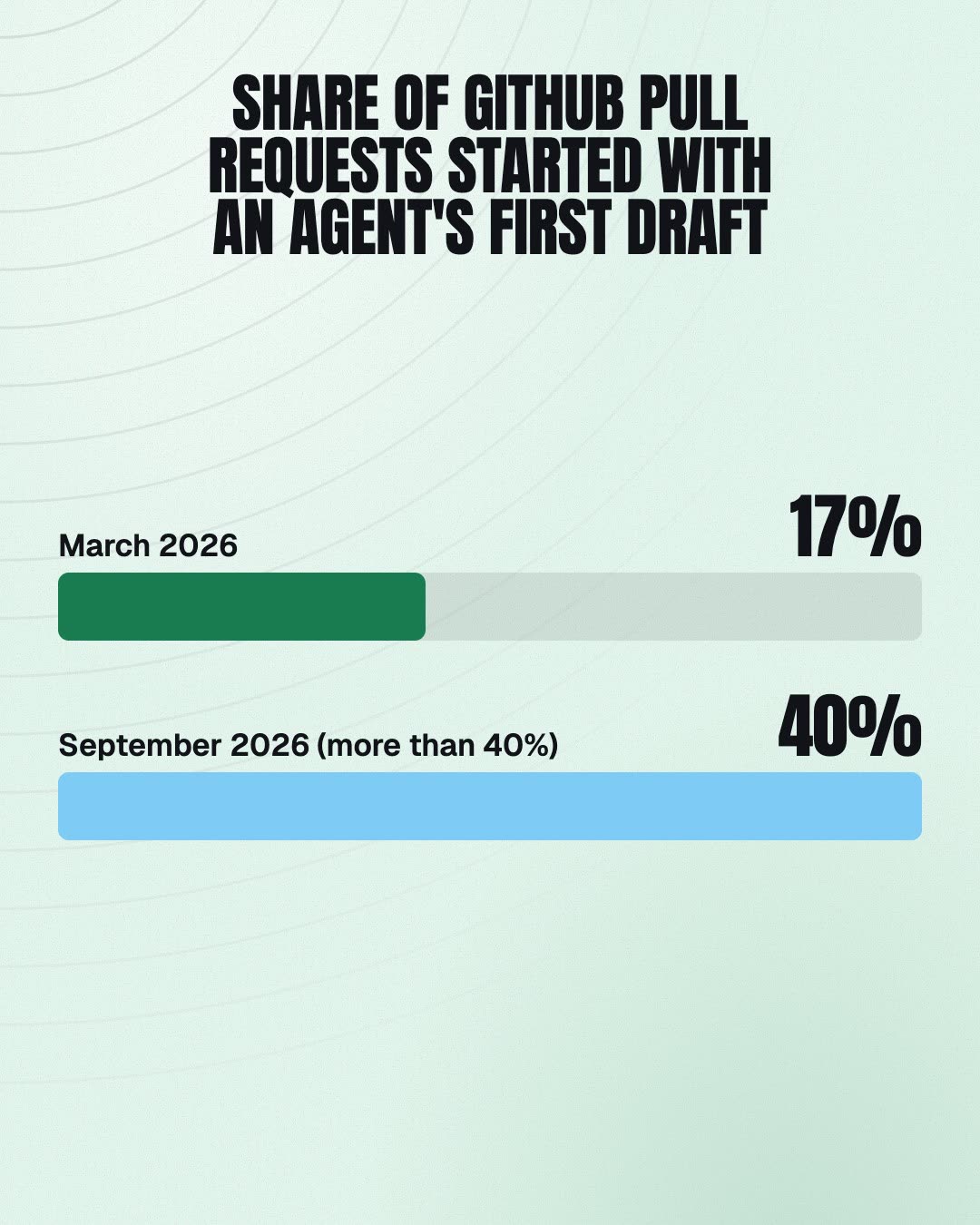
We read the original report and pulled out the numbers that hold up and the things they leave out. After that come a three-rule review policy and a 15-minute way to measure your own repo.
What agent pull requests look like in GitHub's data
Agent PRs are bigger. About 87% change multiple files, compared with 79% of PRs without detected agent involvement. More files means more context for the reviewer to keep in mind, not just more lines to read.
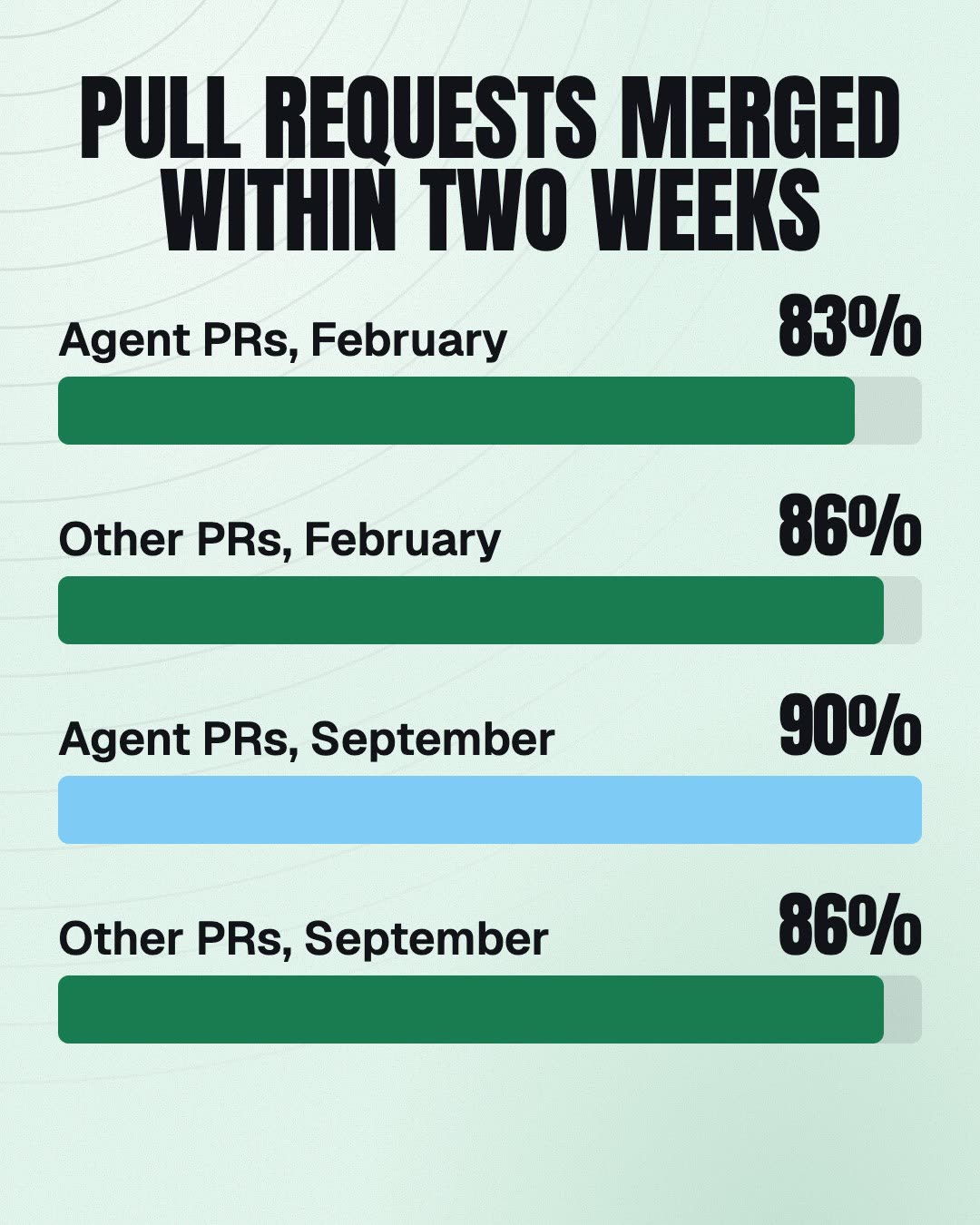
They also merge faster now. In February, 83% of agent-involved PRs merged within two weeks, a little behind the roughly 86% for other PRs. By September, agent PRs were at 90%, while the comparison group stayed at about 86%.
Developers are handing agents whole tasks, not just asking for snippets:
- 55% of Copilot monthly active users now use agentic features, up from 35% a year ago.
- Copilot cloud agent, where you assign a task and the agent works on it independently, grew 230% year over year. Agent chat grew 85%.
- In September, 61% of Copilot users who picked a model themselves used more than one, up from 50% four months earlier.
- Paid Copilot users used 47 distinct models in September, up from 29 in May. No single model carried more than 25% of requests.
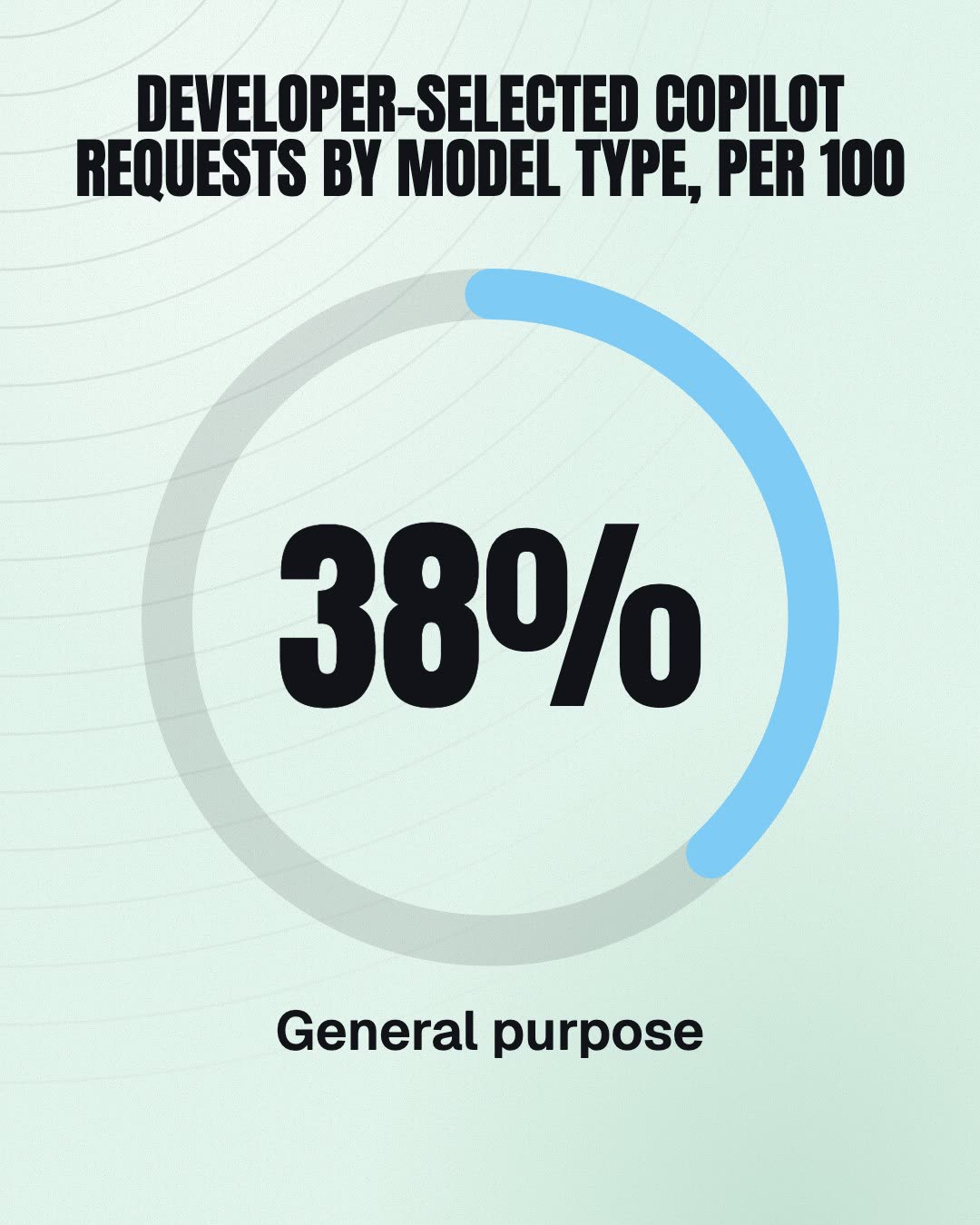
Out of every 100 developer-selected requests, 38 went to general-purpose models, 37 to deep reasoning and planning models and 25 to fast, lightweight ones. So people mix models: a planner for the hard part, a quick model for the rest.
One more figure gets quoted a lot. Among repos created this year, the average repo with an agent configuration file logged eight times as many commits as one without. That's a correlation. Teams that set up agents from day one may simply be the busiest teams, and the number doesn't show that the agents caused the extra commits.
Read the fine print: what the 40% does and doesn't measure
GitHub's definition is precise. An agent-started PR is "a pull request whose first draft came from a coding agent that we can detect." The report calls its agent signal a floor, "since not all agent use may be detected." It doesn't give examples. Our guess is that an agent running locally and pushing under a person's account is one kind of use that may not show up at all.
- The unit is PRs. It doesn't count lines of code, developers or merged work. A one-line typo fix and a 40-file refactor count the same.
- The window is one month. The 40% and the 110 million are September figures. The 1.3 billion merged PRs cover the whole Octoverse year, October 1, 2025 to September 30, 2026. Dividing one by the other gives you a meaningless number.
- It measures speed, not quality. "Merged within two weeks" says nothing about defects, reverts, follow-up fixes or how long review took. A higher merge rate could also mean teams give agents easier tasks.
- The model figures are Copilot-only. They count developer-selected requests and leave out auto model selection, staff usage and requests made with your own API key. GitHub says they "describe observed use, not model quality."
So the trend is real, and it's steep. But nothing in the report tells your team whether agent PRs are any good. Only your own repo data can tell you that.
Why this lands on code review
For a growing share of work, the first move is now directing an agent, and review is how developers shape what comes back.
GitHub, Octoverse 2026
GitHub's platform numbers point the same way. Stacked pull requests split related work into smaller changes you review one after another. They launched as a preview on July 30, and more than 264,000 developers had used them by September. AI-assisted code review and GitHub Advanced Security each grew more than 90% year over year, and push protection ran 5.8 billion secret scans.
Some guardrails are already built in, according to GitHub's docs on reviewing Copilot output:
- If your repo requires approvals, your approval of a Copilot PR you asked for doesn't count. Someone else has to approve it.
- By default, GitHub Actions workflows don't run automatically when Copilot pushes to a PR. Read any change in .github/workflows/ carefully.
- Copilot code review can now approve PRs, but that's off by default. Repo admins can turn it on and choose which file paths Copilot may approve. If new commits are pushed after Copilot approves, its approval is dismissed, the same as a human reviewer's.
For a small team the pressure is simple. Agents make drafts cheap, so review time becomes the bottleneck. Without a policy, that bottleneck quietly turns into rubber-stamping.
A three-rule review policy for agent PRs
This isn't a governance framework. It's three rules a two-person team can follow every day.
Rule 1: someone who didn't start the task approves the latest push
Turn on branch protection or a ruleset with required approving reviews. Then choose one of two settings. You can require the most recent reviewable push to be approved by someone other than the person who pushed it. Or you can dismiss stale approvals when new commits arrive. GitHub's docs say dismissing stale reviews is the safer choice if you're worried about unapproved content being added to an approved PR.
Rule 2: sensitive paths have named owners
Add a CODEOWNERS file that covers auth, billing, migrations, infrastructure and .github/workflows, and turn on Require review from Code Owners. Any PR that touches that code then needs its owner's approval before it merges. Give the CODEOWNERS file an owner as well, so no person or agent can quietly remove the rule. And read any workflow change before you click "Approve and run workflows."
# .github/CODEOWNERS (example: adjust paths and team names)
/src/auth/      @your-org/leads
/src/billing/   @your-org/leads
/migrations/    @your-org/leads
/infra/         @your-org/leads
/.github/       @your-org/leads
Rule 3: big agent PRs get split, and checks must pass
Agent PRs change several files more often than other PRs. When a diff spans layers, like schema, code and config, ask for stacked or smaller PRs. Require status checks to pass before merge. Keep in mind that a green check only means the tests you configured passed. It doesn't mean the change is right.
Optional: if you turn on Copilot approvals, limit them to low-risk paths such as docs and tests, and keep human approval for owned paths.
Try this: measure your own repo's agent share in 15 minutes
- Count all PRs: repo:OWNER/REPO is:pr created:2026-10-01..2026-10-31
- Count agent PRs. If your agents open PRs as an integration account, add author:app/NAME. Use -author:app/NAME to count everything else. If your agents run under a person's account, agree on a label such as agent and filter with label:agent.
- Divide the two counts to get your share. Like GitHub's number, it's a floor.
- Add what the report doesn't have. Use is:merged to count merged agent PRs and is:unmerged is:closed to count closed ones. Note any follow-up fix PRs over the next few weeks.
- Check that review actually happens. review:approved, review:changes_requested and review:none show whether agent PRs are really getting reviewed.
After 30 days, run the same numbers for human PRs and compare. That gives you the quality picture Octoverse can't.
What we'd do
- Treat the 40% as a direction, not a benchmark for your team. Your share depends on your tools and on what you can detect.
- Set up the three rules this week. Branch protection, CODEOWNERS and required checks take one sitting for most small teams.
- Measure for a month. Then decide where agents get a lighter review path (docs, tests) and where they never do (auth, payments, workflows).
Agents now write the first draft of a big share of PRs. Whether that makes your code better gets decided in review. For careful reads of the week's AI data like this one, subscribe to our newsletter.